
How Robotics Companies Should Brand for Two Audiences at Once (Engineers & Procurement)
Most B2B technology brands communicate primarily with one dominant buyer type. Robotics companies operate differently. A robotics company often sells into environments where engineers, operations leaders, procurement teams, and executives all participate in the decision. Each audience evaluates the company through a different lens.
Engineers focus on technical fit, integration logic, implementation feasibility, documentation quality, and system reliability. Procurement evaluates operational stability, delivery risk, governance, support continuity, and commercial predictability. This creates a structural branding challenge because both audiences are evaluating trust, but they define trust differently.
This is why robotics company branding differs from standard SaaS branding. In robotics, the buyer is not only purchasing software access. They are evaluating physical deployment, automation workflows, integration complexity, validation processes, and long term support. Branding therefore becomes a layered communication system rather than a surface level marketing exercise.
Many robotics companies struggle because they over-rely on broad innovation language. Terms like intelligent machines, cutting edge technology, and advanced robotics may communicate ambition, but they often fail to explain deployment realities, implementation discipline, or operational value. This creates ambiguity for both technical and commercial buyers.
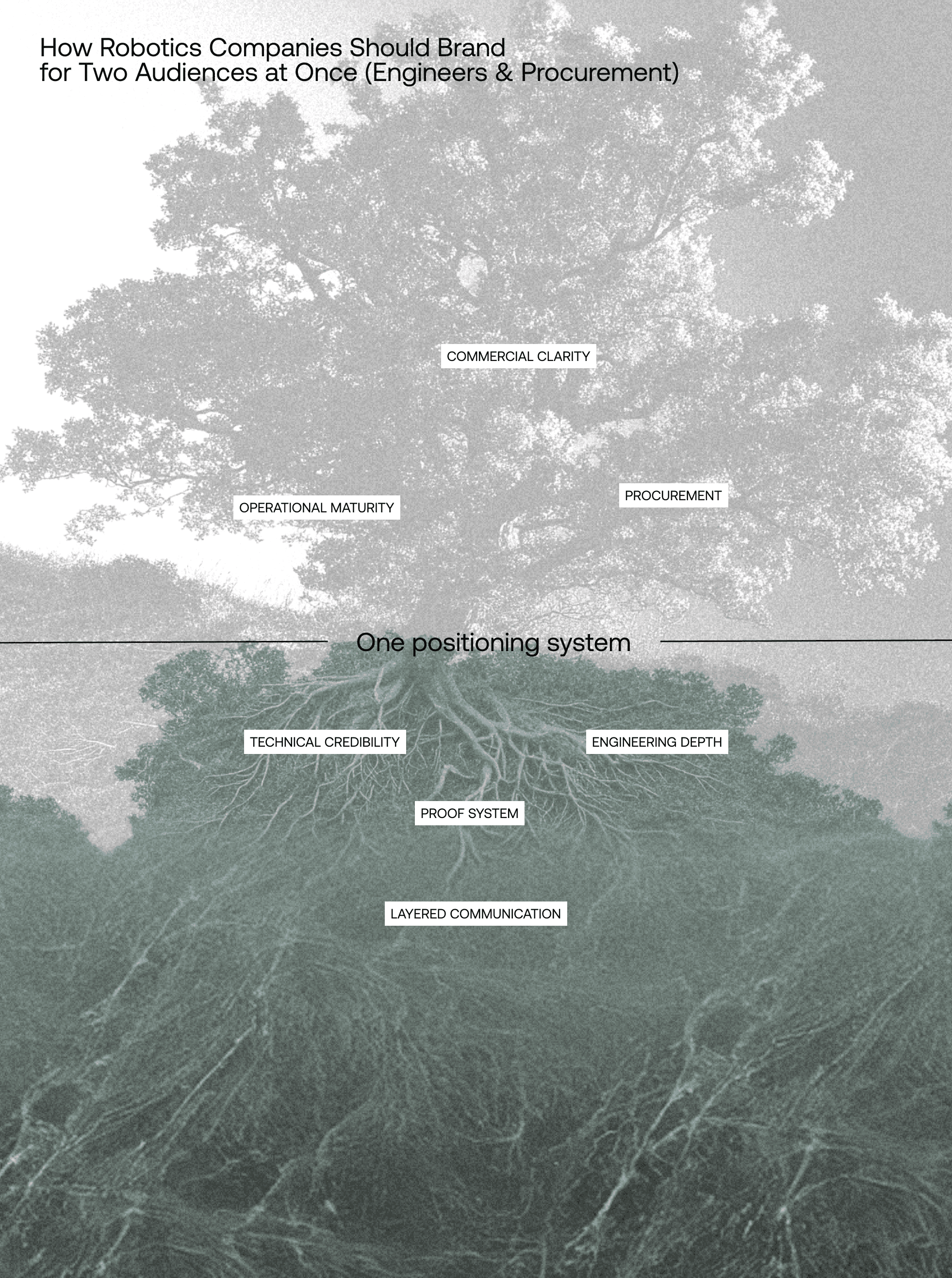
A strong robotics brand must therefore communicate three things simultaneously: technical credibility, operational maturity, and commercial clarity.
How Engineers Evaluate Robotics Brands
Engineers evaluate robotics brands through evidence, coherence, and precision. Unlike broader marketing audiences, they are usually skeptical of abstraction and highly sensitive to vague language.
For technical audiences, documentation is not supporting material. It is part of the product experience itself. Architecture diagrams, integration pathways, validation processes, testing methodology, interoperability details, and implementation logic all contribute to brand perception. These materials signal engineering maturity and disciplined thinking.
This means brand strategy for robotics companies must extend into technical communication systems. Engineers want clarity around constraints, deployment conditions, supported environments, and operational detail. They are often more persuaded by evidence of process and repeatability than by visionary messaging.
Visual and verbal identity also influence technical trust. Engineers tend to associate consistency, structure, and precision with competence. Clean typography, organized layouts, disciplined terminology, and technically accurate messaging reinforce the perception that the company understands complexity and can manage it reliably.
This is why many engineering audiences reject generic technology branding. If the website language sounds broad while the technical depth is shallow, trust declines quickly. Complexity itself is not necessarily a problem for engineers. Imprecision is.
For robotics companies, branding should therefore make technical clarity visible. The goal is not to simplify away complexity, but to communicate it in a structured and credible way.
How Procurement Teams Evaluate Robotics Companies
Procurement teams evaluate robotics companies differently. Their primary concern is usually not technological novelty alone, but implementation risk and operational reliability.
In enterprise robotics environments, procurement often assesses certifications, project governance, support structure, staffing quality, service continuity, and vendor stability alongside technical capability. This means branding influences perception long before final technical evaluation begins.
A procurement audience looks for signs of maturity. Consistent messaging, organized documentation, clear implementation processes, case studies, and structured communication systems all contribute to confidence. Inconsistency between proposals, website content, pitch decks, and service descriptions can increase perceived risk.
This is why robotics branding must communicate operational discipline as clearly as technological prowess. Procurement teams want to know that the company can deliver projects predictably, support deployments long term, and operate professionally within large enterprise environments.
Visual identity matters here as well. A fragmented or improvised brand system may unconsciously signal organizational instability. A coherent identity system suggests process maturity, reliability, and accountability.
For procurement stakeholders, branding functions as a risk reduction layer. It helps answer whether the company is dependable enough to implement advanced technology successfully at scale.
Building a Brand Strategy That Works for Both Audiences
The solution is not creating two separate brands. Strong robotics companies build one strategic positioning system with multiple communication layers.
At the center is a shared brand identity built on a clear vision, mission, and unique value proposition that defines the company’s competence domain, deployment philosophy, strategic promise, and brand values. This core should resonate with the target audience and foster loyalty over time. This core narrative should remain stable across all audiences. A well-defined mission statement acts as a compass across branding efforts and should clarify why customers should choose the company over competitors. What changes is the level of abstraction and the supporting evidence.
For engineers, messaging should emphasize implementation logic, technical detail, documentation quality, and system integration. For procurement, the emphasis shifts toward operational maturity, delivery reliability, governance, and commercial confidence. Both layers should reinforce the same underlying positioning.
This layered model prevents fragmentation. When technical and commercial narratives drift apart, buyers perceive internal misalignment. When both narratives feel connected, the company appears more disciplined and trustworthy.
A practical framework for robotics company branding often includes:
a core positioning narrative
a technical messaging layer
a commercial messaging layer
a proof system built around testing, deployment, certifications, and case evidence
This structure is a powerful tool to develop communication without weakening the overall brand and can help the strongest companies lead their category. Purpose-led companies often grow faster than those focused only on performance.
Visual Identity and Design Elements for Robotics Companies: Precision Without Coldness
Many robotics brands look interchangeable. The category is saturated with dark gradients, glowing AI imagery, futuristic symbols, and abstract technology aesthetics that communicate “innovation” but fail to create distinction. A strong logo plays a crucial role in that visual identity: it should stand out in a competitive field without defaulting to a generic robotics shape or familiar AI cues.
A stronger visual identity for robotics companies should communicate precision, sophistication, and clarity without becoming emotionally distant. In industrial and automation environments, buyers often associate disciplined design systems with engineering maturity and operational competence. Every visual choice should feel innovative while still helping the system reflect the brand's personality.
Typography plays an important role. Structured layouts, geometric letterforms, restrained color choices, and consistent spacing systems can communicate precision engineering more effectively than decorative futurist visuals. Strong design principles matter here: simplicity and disciplined layout help a mark capture the brand's essence and stay a memorable logo. Even small other design elements such as negative space, hierarchy, and grid discipline contribute to the perception of quality.
At the same time, robotics branding should avoid becoming visually hostile or overly technical. Procurement teams, business stakeholders, and partners still need approachable communication. User friendly interfaces, readable typography, and accessible visual systems help reduce cognitive friction. That approachable design also supports an emotional connection and makes complex systems feel more accessible to broader audiences.
This balance is critical because robotics companies are often selling complex systems into environments already perceived as difficult. The brand should make advanced technology feel understandable, not more intimidating. Color choices often lean toward cool tones like blue, gray, and silver to signal trust, professionalism, and tech, while selective bold accents can add energy.
The strongest robotics visual systems therefore combine simplicity, structure, and technical sophistication while remaining usable across websites, product documentation, trade show materials, and proposal systems. A professional logo should be simple enough for instant recognition, distinctive enough to stand apart from competitors, and flexible across various applications, various mediums, and even product packaging.
Website and Content Systems for Robotics Branding
A robotics website must support multiple buyer journeys simultaneously. Engineers need technical depth. Procurement needs operational clarity. Leadership stakeholders need commercial relevance.
This requires layered information architecture built around the specific pain points of each audience segment using the site. A strong robotics website typically combines:
high level positioning pages
technical solution pages
implementation and deployment detail
case studies
proof systems
certifications and testing information
clear conversion paths
Educational resources are especially important here because robotics is often seen as disruptive or novel technology.
The structure matters because different visitors arrive with different questions. Some want to know whether the solution fits their environment and what specific services support deployment. Others want to evaluate deployment reliability or business value, including how the solution helps attract potential customers across the market. A flat content system cannot support all of these needs effectively.
Progressive disclosure is especially important in robotics branding. High level commercial clarity should appear first, followed by deeper technical information for users who need it. This prevents non technical stakeholders from becoming overwhelmed while still giving engineers access to implementation detail.
Case studies are also critical. In robotics, buyers often trust real deployment evidence more than abstract product claims. Strong examples should explain the environment, challenge, implementation scope, measurable outcome, concrete data, and testimonials from early adopters where available, including how the system reduces labor costs, improves workplace safety, or accelerates production in the real world.
High-quality videos of robots performing actual tasks in real-world environments can further strengthen credibility, but all demo footage must be authentic because authenticity is a critical brand asset.
Social media platforms can support recognition and employer branding, but for enterprise robotics companies the website remains the primary trust environment. Buyers need durable, referenceable evidence rather than lightweight brand impressions, while a strong presence on professional platforms helps teams interact directly with clients and gather actionable market feedback and insights across the industry world.
Why Branding Is Becoming a Competitive Advantage in Robotics
The robotics industry is becoming more competitive as automation markets mature and advanced robotics capabilities become more widespread. More companies can now claim innovation, intelligent automation, and cutting edge technology. As capabilities converge, branding helps companies stand apart from direct competition. This makes differentiation harder.
As categories mature, technical superiority alone becomes less effective as a positioning strategy. Buyers increasingly evaluate how understandable, reliable, and deployable the company appears alongside the technology itself.
This is why branding is becoming a competitive advantage. A strong robotics brand reduces ambiguity at the exact point where enterprise trust is formed. It helps buyers understand what the company does, how it works, why it matters, and why it is safer to adopt than competitors. Storytelling is a powerful tool for simplifying complex robotics offerings and making them more memorable.
Branding also shapes market perception internally and externally. It aligns sales, engineering, marketing, and business development around one positioning system. A distinctive brand story can humanize the company, build emotional connection, and support loyalty in a crowded market. This creates more coherent communication across proposals, websites, presentations, and customer conversations.
In robotics, branding is therefore moving closer to infrastructure. It is no longer just a visual layer added after product development. It becomes part of how the company explains complexity, creates confidence, and scales adoption across multiple stakeholders. Companies driven by purpose grow 3x faster than those focused solely on performance, so purpose-led brands are better positioned to lead as the category evolves into the future.
Examples
Boston Dynamics
Boston Dynamics combines highly technical robotics credibility with broad public recognition. Its brand communicates engineering sophistication while using accessible demonstrations and structured storytelling that make advanced robotics understandable beyond purely technical audiences.
ABB Robotics
ABB Robotics demonstrates how industrial robotics branding can support both engineers and procurement stakeholders. Its communication combines technical documentation, implementation detail, operational proof, and enterprise credibility within one consistent brand system.
FAQs
What makes robotics company branding different from SaaS branding?
Robotics branding must communicate technical implementation, operational reliability, and deployment credibility alongside software and automation capabilities.
How should robotics companies communicate with both engineers and procurement teams?
By using one core positioning system with layered messaging adapted to technical and commercial priorities.
Why is visual identity important in robotics branding?
Visual identity influences perceptions of precision, competence, reliability, and organizational maturity in enterprise environments. Its choices should reflect the brand's personality, align with core values, and support recognition across different contexts.
What kind of website works best for robotics companies?
A layered website structure that combines commercial clarity, technical depth, proof systems, and role specific buyer journeys.
How can robotics companies stand out in a competitive market?
By combining technical credibility with clear positioning, operational trust signals, and differentiated brand systems rather than relying only on innovation claims. In a competitive field, that also means sharper differentiation for the target audience and a stronger brand story around their robotics solutions.

Masha is the founder of Bolder, a branding and communications agency for tech startups in AI, robotics, biotech, deep tech, and energy. She’s built three companies and leads a team of talented strategists and designers, helping technical founders turn hard to explain work into brands sharp enough to match the tech behind them.