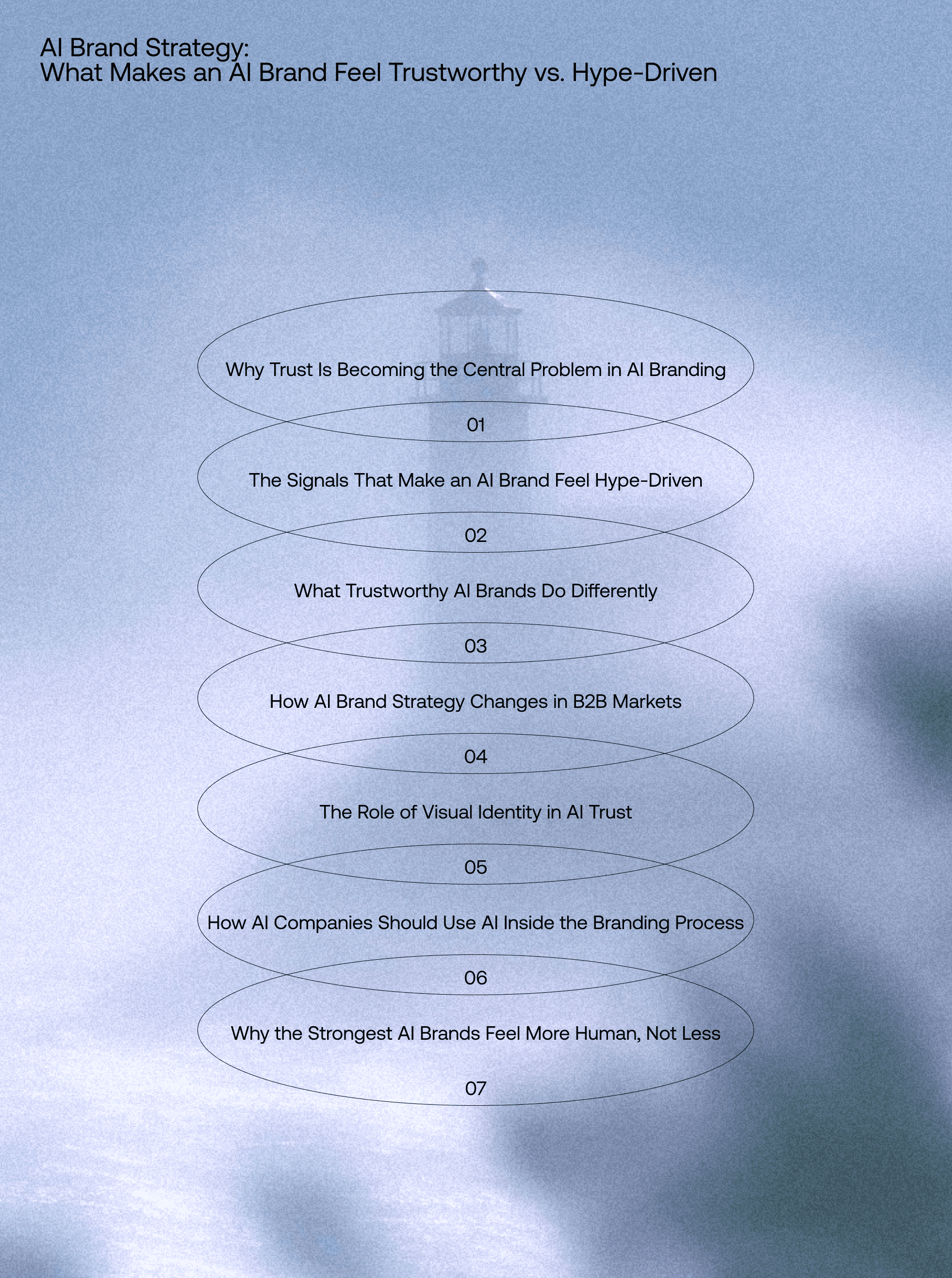
AI Brand Strategy: What Makes an AI Brand Feel Trustworthy vs. Hype-Driven
The AI market is entering a maturity phase where trust matters more than novelty. In the early generative AI cycle, companies could attract attention simply by associating themselves with artificial intelligence, machine learning, or AI-powered workflows. Today that strategy is becoming less effective because the market is saturated with similar claims and increasingly skeptical buyers.
Almost every software company now claims to use AI tools, natural language processing, data analytics, or machine learning algorithms. As a result, many AI brands sound interchangeable. They repeat the same language around transformation, automation, and innovation without clearly explaining what the system actually does, how it fits into a workflow, or where human oversight remains necessary.
This changes the role of AI brand strategy. In maturing AI categories, buyers no longer evaluate only technological ambition. They increasingly evaluate operational credibility. Enterprise customers want to understand how AI works in practice, how customer data is handled, what governance systems exist, and whether the company communicates realistically about limitations and implementation conditions.
In this environment, trust becomes a genuine competitive advantage. The strongest AI brands position artificial intelligence as infrastructure embedded inside real business systems rather than as a magical replacement for human judgment. They focus on operational clarity, workflow improvement, and measurable value instead of abstract futurism.
The Signals That Make an AI Brand Feel Hype Driven
One of the strongest signals of hype driven AI branding is vagueness. Many companies talk about revolutionizing industries or transforming work without defining the actual workflow role of the product. The messaging sounds ambitious, but the audience cannot clearly understand inputs, outputs, limitations, or operating conditions.
Another problem is “magic AI” positioning. Some brands frame artificial intelligence as an autonomous force that replaces expertise, removes decision making complexity, or solves highly contextual business problems automatically. Sophisticated buyers rarely believe these claims because they already understand that AI systems remain probabilistic, context dependent, and operationally constrained.
The same issue appears visually. Many AI companies rely on nearly identical visual identity systems built around dark gradients, glowing abstractions, futuristic interfaces, and generic geometric logos. These aesthetics no longer communicate innovation. They communicate category sameness.
Messaging patterns also contribute to distrust. Phrases such as ai powered, seamless integration, intelligent automation, and future of work are now so overused that they often function as placeholders rather than meaningful positioning. When AI branding relies too heavily on category language, the company starts sounding more like an idea than an operational product.
Trust tends to decline whenever the brand promise becomes larger than the visible proof system supporting it.
What Trustworthy AI Brands Do Differently
Trustworthy AI brands communicate differently because they optimize for clarity rather than maximum excitement. They explain what the product does, where AI is applied, what role humans still play, and what operational boundaries exist.
Strong brand positioning in AI markets is usually more specific than hype driven positioning. Instead of promising universal transformation, trustworthy brands focus on defined workflow improvements, measurable operational value, and concrete use cases. They describe how the system integrates into existing business environments and how customer experience improves through that integration.
Proof systems are especially important in enterprise AI branding. Buyers increasingly expect implementation evidence, customer references, governance explanations, workflow diagrams, and visible operational logic. AI tools can also automatically audit content across platforms to maintain consistency in how brand identity is expressed across touchpoints and catch errors before publication. The strongest AI brands reduce ambiguity at every stage of the customer journey.
Strategic restraint also improves trust. Companies that openly communicate limitations, review processes, or uncertainty often appear more credible than companies presenting AI as infallible. In mature AI categories, accountability signals outperform visionary language.
This changes the structure of the AI brand strategy itself. The strongest brands no longer frame artificial intelligence as the center of the story. Instead, they frame business value, workflow improvement, and operational reliability as the center, with AI functioning as an enabling layer inside that system.
How AI Brand Strategy Changes in B2B Markets
Enterprise AI branding differs significantly from consumer AI branding because the emotional center of the purchase is not curiosity. It is risk-adjusted confidence.
B2B buyers evaluate AI solutions through procurement, legal review, compliance requirements, integration complexity, and long-term operational risk. This means enterprise AI brands must communicate much more than innovation alone. They must communicate reliability, governance, implementation discipline, and support infrastructure.
This is why the strongest B2B AI companies increasingly position AI as workflow augmentation rather than autonomous disruption. Buyers want tools that reduce heavy lifting, improve operational efficiency, and generate insights while still preserving human accountability.
The trust problem becomes even more important in industries handling sensitive customer data or operating under regulatory scrutiny. In these environments, vague AI branding immediately creates perceived risk.
Operational consistency therefore, becomes part of the brand itself. If onboarding, documentation, implementation support, or customer communication contradict the external positioning, trust erodes quickly. Enterprise audiences interpret precision and discipline as signals of organizational maturity.
As AI adoption spreads across industries, enterprise AI branding is becoming less about technological spectacle and more about operational dependability.
The Role of Visual Identity in AI Trust
Visual identity shapes trust before the user interacts with the product. The challenge is that many AI brands visually converge around the same aesthetics: futuristic gradients, abstract intelligence symbolism, sterile interfaces, and interchangeable geometric forms.
In practice, enterprise trust is usually built through visual systems that feel structured, readable, and controlled rather than spectacular. Strong AI visual identity systems emphasize hierarchy, consistency, clarity, and composure. The design communicates operational discipline instead of technological mystique.
Approachable visual systems generally perform better in B2B AI categories because buyers are looking for dependable infrastructure, not symbolic representations of machine superiority. This changes the role of the brand designer and the broader branding process.
The strongest AI brands use restraint intentionally. Rather than overwhelming the audience with futuristic symbolism, they allow product architecture, workflow explanation, customer outcomes, and interface clarity to become the primary trust signals.
This applies not only to the logo or marketing website, but to the entire ecosystem of brand assets, including dashboards, case studies, diagrams, onboarding flows, and procurement documentation. In AI branding, trust emerges from the coherence of the whole communication system.
How AI Companies Should Use AI Inside the Branding Process
AI can significantly improve parts of the branding process when used carefully. The right ai tools are effective for deep research, competitor analysis, transcript synthesis, data analytics, information clustering, and generating alternative messaging structures. They are particularly useful when teams need to process vast amounts of information quickly. That makes AI a cost effective way to streamline brand research, and brands that leverage AI can reduce reliance on slower, more expensive methods, which is especially useful for small businesses.
However, AI becomes much weaker when the task requires strategic judgment, category positioning, or long term narrative direction. Pattern generation is not the same thing as strategic thinking. Teams should start by implementing AI in specific use cases that deliver immediate value, then scale based on performance metrics.
This is why strong brand strategists increasingly treat AI as an operational amplifier rather than an autonomous creative replacement. Automating logistical tasks also gives marketers more space for strategic planning and high-level creativity, which is one of the clearest benefits in practice. AI can accelerate research and synthesis, but human judgment remains central for defining:
brand voice
positioning
strategic differentiation
emotional readability
audience psychology
long-term brand value
Overreliance on AI-generated branding can create a second-order trust problem where the company appears efficient but strategically generic. Many AI-generated verbal systems flatten distinctiveness because they reproduce dominant category language instead of creating differentiated positioning.
The strongest workflows therefore, combine human strategic direction with AI-assisted research and synthesis. AI can support the creative process by providing inspiration for ideas, design directions, messaging, and campaign concepts, while human judgment stays in charge. AI supports the process, but humans remain responsible for meaning, judgment, and strategic coherence.
Why the Strongest AI Brands Feel More Human, Not Less
The strongest AI brands often feel more human because clarity and accountability are easier to trust than abstraction and certainty theater.
Human-centered communication works well in AI markets because buyers want to understand consequences, responsibilities, and workflow implications rather than simply admire technical sophistication. This changes how brand voice functions inside AI branding.
Trustworthy AI brands tend to use calmer messaging, plain language, and more scoped claims. They explain where human oversight remains necessary and avoid presenting AI as an all-knowing system. Interestingly, this strategic restraint often increases credibility.
Sophisticated audiences already understand that AI systems depend on training data, context, governance, and continuous monitoring. AI can also analyze vast amounts of unstructured data from reviews and social media to provide real-time sentiment analysis and track shifting consumer values as well as customer preferences. This gives brands a clearer understanding of consumer behavior and helps them interpret emerging signals more effectively. Brands that openly acknowledge these realities appear more operationally mature than brands projecting absolute certainty.
This does not make the technology feel less advanced. It makes the company feel more accountable. Transparency and consent matter because these systems often rely on large volumes of consumer data. Missteps in ethical data practices can damage trust and trigger regulatory penalties under laws like GDPR and CCPA. Strong data quality and diverse, representative datasets are also necessary to avoid misleading outcomes and reinforced bias.
As artificial intelligence becomes more integrated into everyday business infrastructure, the strongest AI brands will likely be the companies that communicate AI as understandable systems helping people work more effectively rather than as mysterious technologies transforming the world overnight.
Examples
Anthropic
Anthropic positions itself around AI safety, governance, and responsible deployment rather than pure disruption rhetoric. Its communication consistently emphasizes accountability, operational control, and measured scaling.
Notion AI
Notion AI frames artificial intelligence as workflow support rather than replacement. The messaging focuses on reducing manual work inside existing productivity systems while preserving human control over outputs.
FAQs
Why do many AI brands feel untrustworthy?
Many AI brands rely on vague positioning, exaggerated promises, generic visual identity systems, and weak proof structures that create skepticism instead of confidence.
What makes an AI company brand feel credible?
Operational clarity, visible governance, realistic messaging, customer evidence, and transparent communication about limitations all improve AI brand trust.
How should AI companies position themselves?
AI companies should position artificial intelligence as a practical capability layer that improves workflows and operational systems rather than as magical replacement technology.
Why do so many AI startups look the same?
Many AI startups rely on identical futuristic aesthetics, gradients, abstract intelligence symbolism, and generic AI-powered messaging patterns.
Can AI tools help with branding strategy?
Yes. AI tools can support research, synthesis, analysis, and workflow efficiency, but human judgment remains essential for positioning, differentiation, and strategic direction. They also enhance brand research with real-time insight into shifting customer preferences, competitor activity, market trends, and broader changes across the industry, so teams can adjust marketing strategies faster. AI-enabled predictive analytics, powered by historical data, emerging patterns, and emerging technologies, helps brands anticipate future shifts and generate actionable insights. That also improves segmentation by revealing hidden patterns and untapped opportunities, helping brands define a target audience and target market based on behavior, preferences, and demographics. Sentiment analysis across reviews, surveys, and social media helps brands understand how individual consumers feel, and with 67% of consumers influenced by online sentiment, that signal can materially shape decisions.

Masha is the founder of Bolder, a branding and communications agency for tech startups in AI, robotics, biotech, deep tech, and energy. She’s built three companies and leads a team of talented strategists and designers, helping technical founders turn hard to explain work into brands sharp enough to match the tech behind them.