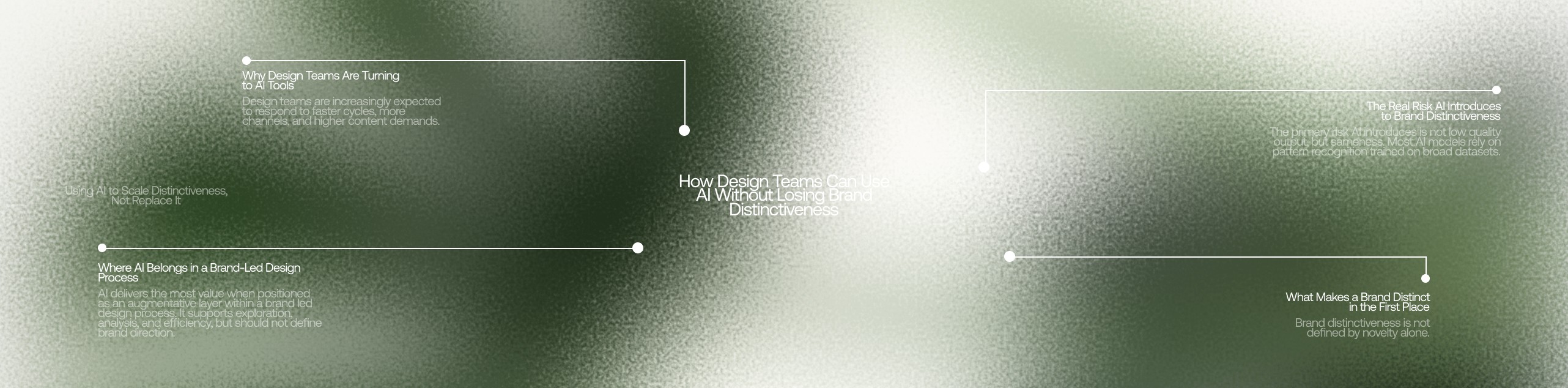

How Design Teams Can Use AI Without Losing Brand Distinctiveness
Artificial intelligence has become an integral part of modern design processes. AI tools now support everything from early ideation to production, from analyzing historical data to generating visual elements at scale. For design teams, this shift promises speed, efficiency, and access to valuable insights. At the same time, it introduces a real strategic risk. When AI systems begin to shape creative output without clear brand guardrails, brand distinctiveness can quietly erode.
The challenge for design teams is not whether to embrace AI, but how to incorporate AI without compromising what makes a brand instantly recognizable, culturally grounded, and emotionally resonant. Leveraging data-driven insights and collaborating closely with data scientists and product managers is essential to ensure AI enhances creativity while supporting brand distinctiveness.
Why Design Teams Are Turning to AI Tools
Design teams are increasingly expected to respond to faster cycles, more channels, and higher content demands. AI powered tools help address these pressures by automating repetitive tasks, accelerating early exploration, and enabling teams to analyze vast amounts of data that would otherwise be inaccessible.
Common use cases include:
• AI driven user research that surfaces patterns in user behavior
• Sentiment analysis to gauge user sentiment across large datasets
• Predictive analytics to identify emerging market trends
• AI generated ideas that help overcome creative blocks during early stages
• Using generative ai to create new design concepts and experiences
AI also enables the creation of personalized experiences by tailoring interactions and content to individual user preferences, enhancing engagement and satisfaction.
By analyzing historical data and large datasets, AI provides deeper insights into user expectations and consumer behavior. For many teams, this data driven layer becomes a valuable input into the design thinking process, informing more informed decision making without replacing human creativity. Teams can leverage AI to rapidly generate low-fidelity concepts, allowing human designers to focus on the final details and emotional elements.
The Real Risk AI Introduces to Brand Distinctiveness
The primary risk AI introduces is not low quality output, but sameness. Most AI models rely on pattern recognition trained on broad datasets. As a result, AI generated ideas often converge toward familiar visual styles, popular design elements, and widely accepted aesthetic norms.
When teams rely too heavily on AI driven tools, brands can lose their unique visual language, tone, and cultural specificity. Over time, this leads to:
• Homogenized visual elements across competing brands
• Reduced instant recognition in crowded markets
• Weaker emotional connection with users
• Brands that feel interchangeable rather than distinctive
Brands fail not because AI is ineffective, but because AI is applied without a clear understanding of what makes the brand different in the first place.
What Makes a Brand Distinct in the First Place
Brand distinctiveness is not defined by novelty alone. It is built through consistent use of recognizable design elements, clear brand signals, and a deep connection to cultural context and user needs.
Key components of distinct brands include:
• A coherent visual system, not isolated assets
• Consistent application of design elements across touchpoints
• Strong alignment between brand values and user experiences
• A recognizable aesthetic that holds over time
The Nike swoosh logo is a useful reference point. Its power does not come from constant reinvention, but from consistent use over decades. Distinctiveness is created through repetition with intent, not endless variation.
Successful brands maintain their distinctiveness by consistently showcasing their unique assets and values. For example, Innocent Drinks' playful brand voice and distinctive communication style have directly contributed to capturing a significant market share in the UK smoothie industry.
Where AI Belongs in a Brand-Led Design Process
AI delivers the most value when positioned as an augmentative layer within a brand led design process. It supports exploration, analysis, and efficiency, but should not define brand direction.
AI fits best in areas such as:
• Analyzing user feedback and market research at scale
• Supporting early exploration of creative ideas
• Identifying patterns in user behavior and style preferences
• Accelerating production of assets that already follow brand guidelines
Where AI does not belong is in defining brand identity, core visual systems, or brand meaning. These decisions require human judgment, cultural awareness, and hands on experience that AI capabilities cannot replicate.
How Design Teams Can Use AI Without Diluting the Brand
To harness AI without losing brand distinctiveness, teams need clear operational guardrails. AI should operate within defined constraints rather than open-ended creative freedom.
Effective practices include:
• Feeding AI systems with brand specific inputs, not generic prompts
• Evaluating AI generated ideas against brand guidelines
• Treating AI outputs as starting points, not final solutions
• Maintaining human review at every critical decision point
AI can significantly enhance creative output when teams retain authorship and accountability. Without these controls, AI driven design risks drifting off brand without immediate visibility.
The Role of Design Systems and Brand Guidelines in AI Workflows
Design systems and brand guidelines play a crucial role in AI enabled workflows. As AI continues to scale production, weak or outdated systems amplify inconsistency rather than control it.
Strong brand systems:
• Define acceptable visual elements and usage
• Standardize design processes across teams
• Enable consistent use across new tools and platforms
• Protect brand integrity as output volume increases
Tools like Adobe Photoshop increasingly integrate AI capabilities. Without strong systems in place, these tools accelerate inconsistency instead of reinforcing coherence.
Why Human Judgment Still Defines Brand Quality
AI excels at processing data, identifying patterns, and generating options. It does not understand cultural nuance, emotional resonance, or brand meaning. These dimensions require human interpretation.
Human judgment remains essential for:
• Interpreting user sentiment beyond quantitative signals
• Understanding cultural context and market nuance
• Making tradeoffs between efficiency and expression
• Ensuring human connection in user experiences
Design quality ultimately depends on taste, intention, and context, areas where human creativity remains irreplaceable.
Using AI to Scale Distinctiveness, Not Replace It
When used strategically, AI becomes a force multiplier for brand distinctiveness rather than a threat to it. It enables teams to scale consistent brand expression, personalize experiences, and respond to market trends without sacrificing identity.
The most effective teams treat AI as an integral part of a broader system, not a shortcut. By combining AI driven insights with strong brand foundations and human judgment, design teams can enter a new era where technology supports creativity instead of flattening it.
AI marks a paradigm shift in design workflows. Brand distinctiveness will not disappear, but it will increasingly depend on how intentionally teams choose to use the tools available to them.
Real-World Examples: How Tech Companies Use AI Without Losing Brand Distinctiveness
Several technology companies show how AI can support design teams without flattening brand identity, when it is embedded into strong systems rather than used as a creative shortcut.
Figma integrates AI capabilities into an already rigid design system environment. AI supports repetitive tasks, layout exploration, and workflow acceleration, but brand distinctiveness remains protected by shared components, libraries, and clear design constraints. AI enhances speed, while human designers retain control over visual language, hierarchy, and brand expression.

Stripe applies AI driven insights primarily at the level of data analysis and user experience optimization, not brand authorship. AI helps analyze user behavior and surface friction points across complex financial products, while Stripe’s brand identity, visual elements, and tone remain tightly governed. This separation allows AI to improve clarity and usability without interfering with what makes the brand instantly recognizable.
In both cases, AI is treated as an operational amplifier, not a source of identity. Brand distinctiveness is preserved because systems, guidelines, and human judgment define the boundaries within which AI operates.