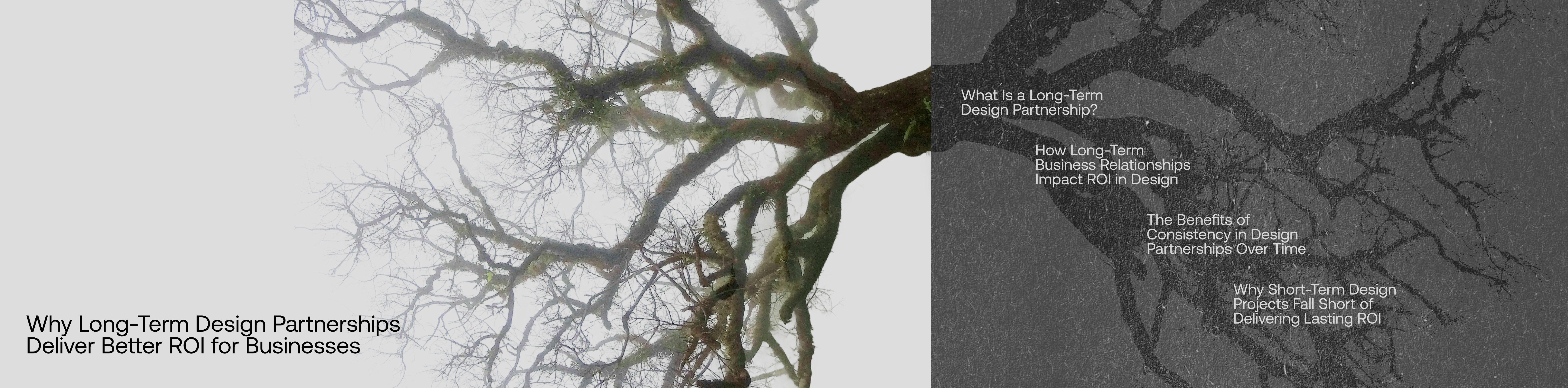
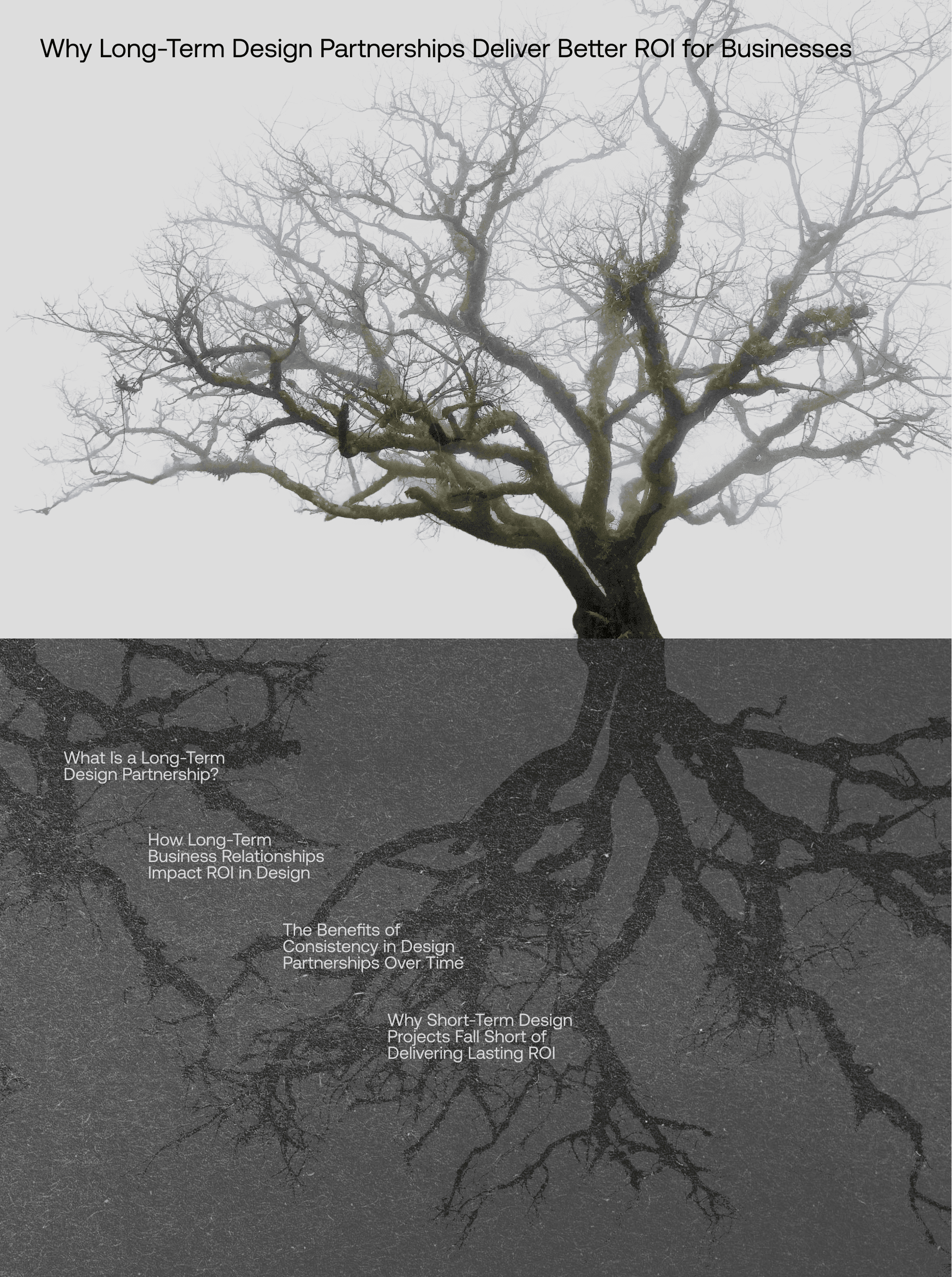
Why Long-Term Design Partnerships Deliver Better ROI for Businesses
Companies often treat design as a project-based service: a rebrand, a website launch, or a marketing campaign delivered by an external vendor. While this approach can solve short-term needs, it rarely creates sustained business value. As companies scale, they discover that design is not a one-time deliverable but an ongoing capability that supports marketing, product development, and customer experience.
Building strong, lasting relationships with clients sets you apart from the competition and transcends mere transactions. The key to long-term success lies in building trust with clients—establishing reliable, transparent, and honest partnerships that foster collaboration and drive growth.
This is why many organizations move toward long term partnerships with design partners rather than relying on isolated projects. A stable partnership allows both sides to build trust, align on business goals, and develop shared processes for delivering consistent design work over time. Building trust is not something that happens overnight; it has to be taken care of and revisited as often as possible. Instead of optimizing for short term gains, companies focus on long lasting business relationships that support continuous improvement, predictable outcomes, and stronger brand execution across teams.
When design partners become part of the broader business ecosystem—working closely with project managers, developers, and marketing teams—the relationship shifts from vendor management to strategic collaboration. Earning trust means showing up consistently and delivering on promises, which strengthens relationships and fosters ongoing collaboration. Over time, this creates a foundation for mutual growth, better decision making, and higher return on investment from design initiatives. Design-led companies in long-term relationships have historically outperformed the S&P by 211%, underscoring the business value of these partnerships.
What Is a Long-Term Design Partnership?
A long term design partnership is an ongoing collaboration between a company and a design partner that spans multiple initiatives over months or years. Instead of working together only on individual projects, both parties develop an enduring business relationship focused on delivering value across campaigns, products, and brand development.
These partnerships are built around shared goals and consistent communication. Regular updates and transparent reporting foster accountability and collaboration, enabling proactive problem-solving. A project team may include designers, developers, strategists, and a project manager who coordinates the collaboration between organizations. As the relationship matures, both sides develop a deeper understanding of each other’s workflows, expectations, and priorities. Both parties should revisit and discuss the objectives from previous meetings to assess progress and address new challenges.
Unlike short term engagements, long term partnerships emphasize alignment and trust. The design partner gradually learns the company’s brand strategy, messaging framework, customer needs, and industry context. This accumulated knowledge allows the partner to contribute more effectively to business decisions and propose solutions that support long-term growth rather than isolated deliverables.
Over time, the relationship evolves from a transactional service model to a strategic collaboration. It becomes essential to plan phased investments and growth strategies to ensure predictable costs and scalable development. Companies begin to rely on their design partner not only for execution but also for insight, creative direction, and innovation opportunities.
How Long-Term Business Relationships Impact ROI in Design
Long term business relationships directly affect ROI because they reduce operational friction and improve the quality of creative output. Each new agency or freelancer typically requires onboarding: learning brand guidelines, internal tools, stakeholders, and approval processes. These onboarding cycles are time consuming and often repeated whenever a company switches vendors.
In long term partnerships, this knowledge compounds instead of resetting. The design partner already understands the brand systems, communication patterns, and decision-making structure of the organization. As a result, projects move faster, require fewer revisions, and demand less supervision from internal teams. Ongoing design support also ensures a cohesive user experience (UX) that fosters customer loyalty and leads to higher customer lifetime value (CLV).
This efficiency has a direct impact on marketing performance. Strong client relationships enable consistent design execution across campaigns, websites, product interfaces, and marketing materials. Consistency strengthens brand recognition, builds trust with customers, and improves the effectiveness of marketing efforts. Notably, improving customer retention by just 5% can boost profits by 25–95%.
Research on agency–client relationships also shows that strong business relationships correlate with more effective marketing outcomes. When a design partner understands the company’s long-term strategy, they can align creative work with business goals rather than treating each project as a standalone task. Research indicates that design-led companies can outperform the S&P 500 by 228% over a decade. This alignment allows design to support broader objectives such as customer acquisition, brand positioning, and market expansion.
Additionally, the tools and systems that support these partnerships—such as collaborative platforms and integrated software—play a critical role in driving innovation and scalability over time.
The Benefits of Consistency in Design Partnerships Over Time
Consistency is one of the most important advantages of long-term partnerships. Over time, design teams accumulate deep knowledge about the company’s brand story, tone of voice, visual identity, and product ecosystem. Making consistency a priority is essential for long-term partnership success, as it ensures that all efforts are aligned with brand standards and strategic priorities.
Established partnerships also enable more efficient workflows. Teams develop shared processes for briefing, feedback, and approvals. Communication becomes faster and clearer because both sides understand expectations and responsibilities. In practice, ongoing activities such as team engagement, open communication, and responsibility sharing are crucial for building effective business relationships and nurturing trust. Constructive feedback becomes easier to exchange, which supports continuous improvement in the design process.
Another advantage is the ability to maintain coherence across marketing channels. In modern businesses, customers encounter brands through websites, products, advertising, social media, and sales materials. Maintaining a consistent experience across these touchpoints requires coordination that is difficult to achieve when multiple short-term vendors are involved. Consistent design across all touchpoints reduces customer friction and builds trust, potentially increasing revenue by 10–20%.
Long term partners can also contribute to innovation. Because they understand the company’s long-term vision, they can identify opportunities for new features, creative campaigns, or improved user experiences. This deeper collaboration strengthens the relationship and creates new opportunities for both parties.
Why Short-Term Design Projects Fall Short of Delivering Lasting ROI
Short-term projects often fail to generate lasting ROI because they prioritize immediate delivery rather than long-term impact. When companies work with new vendors for each project, they repeatedly invest time in onboarding, knowledge transfer, and coordination. Each project begins with limited context, which increases the likelihood of misunderstandings and revisions.
Short term engagements also limit strategic influence. Vendors working on isolated assignments rarely see the full picture of the company’s marketing strategy or product roadmap. As a result, their work may solve immediate problems but fail to contribute to broader brand development or customer experience goals.
Another challenge is fragmentation. When multiple agencies or freelancers contribute to different projects, design systems and messaging can become inconsistent. Customers encounter different interpretations of the brand across marketing channels, which weakens brand recognition and credibility.
Finally, project-based relationships often discourage experimentation and long-term thinking. Because each engagement is limited in scope, vendors focus on delivering exactly what was requested rather than exploring new opportunities or proposing improvements that could benefit the company in the future.
How to Establish a Successful Long-Term Design Partnership for Your Business
Building a successful long term partnership requires more than signing a contract. It begins with selecting a partner whose expertise, culture, and working style align with the company’s goals. The best partnerships are built on shared values, mutual respect, and a shared vision for growth. Listening to the client's needs and adapting accordingly is essential for maintaining strong, productive relationships.
Clear communication structures are essential. Companies should establish regular check-ins, feedback sessions, and collaborative planning processes to ensure that both teams remain aligned. Being open and transparent about your intentions allows both sides of a business relationship to know where they stand. A dedicated project manager often plays a key role in coordinating communication between internal teams and the external design partner.
Setting clear expectations is equally important. Both parties should agree on priorities, deliverables, timelines, and performance metrics. When expectations are transparent, the partnership becomes easier to manage and more resilient during challenging projects. Flexibility and patience are important for strong partnerships, especially during challenging times.
Over time, successful partnerships evolve into trusted collaborations where both sides contribute ideas and insights. Building trust through ongoing engagement with other teams fosters open communication and collaboration. Instead of simply delivering design services, the partner becomes an extension of the company’s internal team. Constructive criticism in a partnership can refine ideas and demonstrate a commitment to delivering value. This deeper collaboration allows organizations to strengthen their brand, respond to new opportunities, and maintain a clear creative direction as they grow.
Examples
Here are three examples of successful long-term design partnerships that illustrate how ongoing collaboration delivers better ROI:
Airbnb
Airbnb is widely recognized for its design-led culture, where design teams collaborate closely with product, marketing, and engineering teams. Each person involved—whether a designer, engineer, or marketer—plays a crucial role in building trust and ensuring seamless communication. Continuous investment in brand storytelling, interface design, and customer experience has helped the company build strong trust with users and differentiate itself in the travel industry. Long-term partners at Airbnb also act as strategic advisors, helping with technology roadmap planning to align design and product evolution. This long-term focus on design demonstrates how sustained collaboration can strengthen both brand identity and business performance.
Slack
Slack invested heavily in building a comprehensive brand center that consolidates design guidelines, assets, and communication principles. This long-term approach allows internal teams and external partners to produce consistent brand assets across global campaigns and product experiences. Shared tools and collaboration systems also help Slack maintain efficient communication with external partners. Long-term partnerships at Slack allow for faster iterations and reduced time-to-market, enabling the company to quickly adapt to changing needs and opportunities.
Stripe
Stripe’s Brand Studio collaborates with internal teams and external partners to maintain a cohesive design system across marketing campaigns, events, and product interfaces. By integrating design into long-term strategy rather than treating it as a separate function, Stripe ensures that its brand identity evolves consistently as the company scales globally. Long-term partnerships at Stripe also enable faster iterations and time-to-market, supporting rapid growth and innovation.
FAQs
How do you calculate the ROI of a design partnership?
Companies usually measure ROI by comparing the financial impact of design-driven initiatives—such as increased revenue, higher conversion rates, or improved lead generation—with the total cost of design services. Long-term partnerships often produce higher ROI because efficiency and brand consistency improve over time. After establishing a long-term partnership, the next steps should include regular check-ins and strategic planning sessions to ensure ongoing alignment, adaptability, and continuous progress toward shared goals.
What are the benefits of a long-term business relationship in branding?
Long-term partnerships strengthen brand consistency, improve communication between teams, and allow design partners to understand the company’s strategy deeply. This leads to more effective campaigns and stronger brand equity. Additionally, long-term partnerships provide stability, drive innovation, and foster a culture of continuous growth and mutual support.
Does a design subscription offer better ROI than an in-house hire?
In some cases, yes. Design subscriptions can provide access to multiple skills and flexible capacity at a lower cost than hiring full-time designers. Many companies combine internal teams with external design partners to achieve the best balance between expertise and scalability.
Final Thoughts
Long-term design partnerships deliver better ROI by providing stability, driving innovation, and fostering a culture of continuous growth and mutual support. Prioritizing long-term planning, collaboration, and strategic partnerships is essential for maximizing technology ROI and supporting sustained business growth.

Masha is the founder of Bolder, a branding and communications agency for tech startups in AI, robotics, biotech, deep tech, and energy. She’s built three companies and leads a team of talented strategists and designers, helping technical founders turn hard to explain work into brands sharp enough to match the tech behind them.