

Where AI Speeds Up Branding Work, and Where It Still Falls Short
AI branding is already useful for a significant part of the branding process. Artificial intelligence can analyze large amounts of market and customer data, accelerate competitor research, generate content variations, produce logo ideas, and create visual directions in minutes. For marketing and design teams, that makes AI particularly effective at reducing repetitive work and expanding the number of options that can be explored before a decision is made.
But speed is not the same as judgment. The strongest use of AI in branding is as an operational layer around human led brand strategy, not as a replacement for it. AI tools can generate options, identify patterns, and help maintain brand consistency once the rules are clear. They are much less reliable at deciding what a brand should stand for, defining a defensible competitive position, or creating a visual identity that is both original and meaningful. A useful distinction is simple: AI is fast at options. Humans are fast at conviction.
What AI actually does well in branding today
The most useful AI branding tools tend to perform well where the task involves scale, repetition, pattern recognition, or rapid variation. They can process information faster than human teams and create a larger initial solution space, provided someone is still responsible for deciding what matters.
Research, competitor scans, and first-draft copy
Research is one of the clearest applications. AI tools can process competitor websites, customer reviews, industry reports, social media conversations, and other sources much faster than a researcher working manually.
Natural language processing can help teams:
summarize large research documents
identify recurring themes in customer feedback
analyze sentiment in reviews and social media content
extract competitors' positioning and messaging patterns
identify potential market gaps and customer pain points
turn large amounts of qualitative information into structured inputs
This makes AI particularly useful during the exploratory phase of brand strategy. Instead of spending hours manually assembling a competitor matrix, teams can use AI to create a first pass and spend more time interpreting what the patterns mean.
The distinction matters. AI can generate insights from data, but it does not automatically know which insights are strategically important. Research platforms that incorporate AI summarization typically position it as an aid to human analysis rather than a substitute for interpretation.
The same principle applies to content creation. Generative AI is effective at producing first drafts of web copy, social media posts, FAQs, product descriptions, campaign concepts, and alternative headlines. For a global brand producing content across multiple channels, this can substantially increase production capacity.
AI can also use existing brand guidelines and examples of brand voice to produce more consistent variations. Machine learning systems can analyze customer data and adapt messaging for different audience segments, while marketers can use AI to personalize content without manually producing every variation.
But the first draft still needs review. Technical accuracy, factual verification, brand personality, compliance, and final editorial judgment remain human responsibilities. AI is useful because it gets the team from zero to something faster, not because the first output should automatically become the final one.
Speeding up moodboards, naming lists, and visual exploration
Generative AI is equally effective during early creative exploration.
A designer can use it to generate:
moodboard imagery
initial visual territories
campaign ideas
color and style references
logo ideas
naming directions
concept mockups
image variations
An AI logo maker, for example, can produce hundreds of logo combinations from a company name, industry, and stylistic preferences. Tools such as Looka can then apply selected brand elements to customizable templates for social media, business cards, websites, and other assets.
Naming works similarly. AI can produce dozens or hundreds of possible names from a strategic brief, explore linguistic territories, and create variations much faster than manual brainstorming alone.
The value here is not that AI makes the decision. It increases the number of possibilities available for evaluation.
Moodboards provide another useful example. Generative AI can quickly visualize directions that would previously require hours of image sourcing. A designer can explore what a more technical, human, restrained, or experimental visual language might look like before committing to a direction.
Used this way, generative AI supports creativity without replacing creative direction.
Where AI branding tools break down
The limitations of AI in branding become more visible as the task moves from generating possibilities toward making consequential decisions.
AI is good at answering, "What could this look or sound like?"
It is much weaker at answering, "Which direction should this company own, and why?"
Strategic positioning and differentiation
Brand positioning is fundamentally a choice.
A company cannot meaningfully occupy every possible position. It has to decide which audience matters most, which competitive frame it wants to operate within, what it wants to be known for, and which parts of the business it is willing not to emphasize.
AI can assist this process. It can map competitors, identify common category claims, generate possible positioning statements, and even propose alternative strategic territories.
What it cannot do reliably is choose which tradeoff the business should make.
That requires an understanding of company ambition, competitive position, product reality, customer behavior, leadership conviction, and future business strategy. Those inputs are often incomplete, contradictory, and politically sensitive.
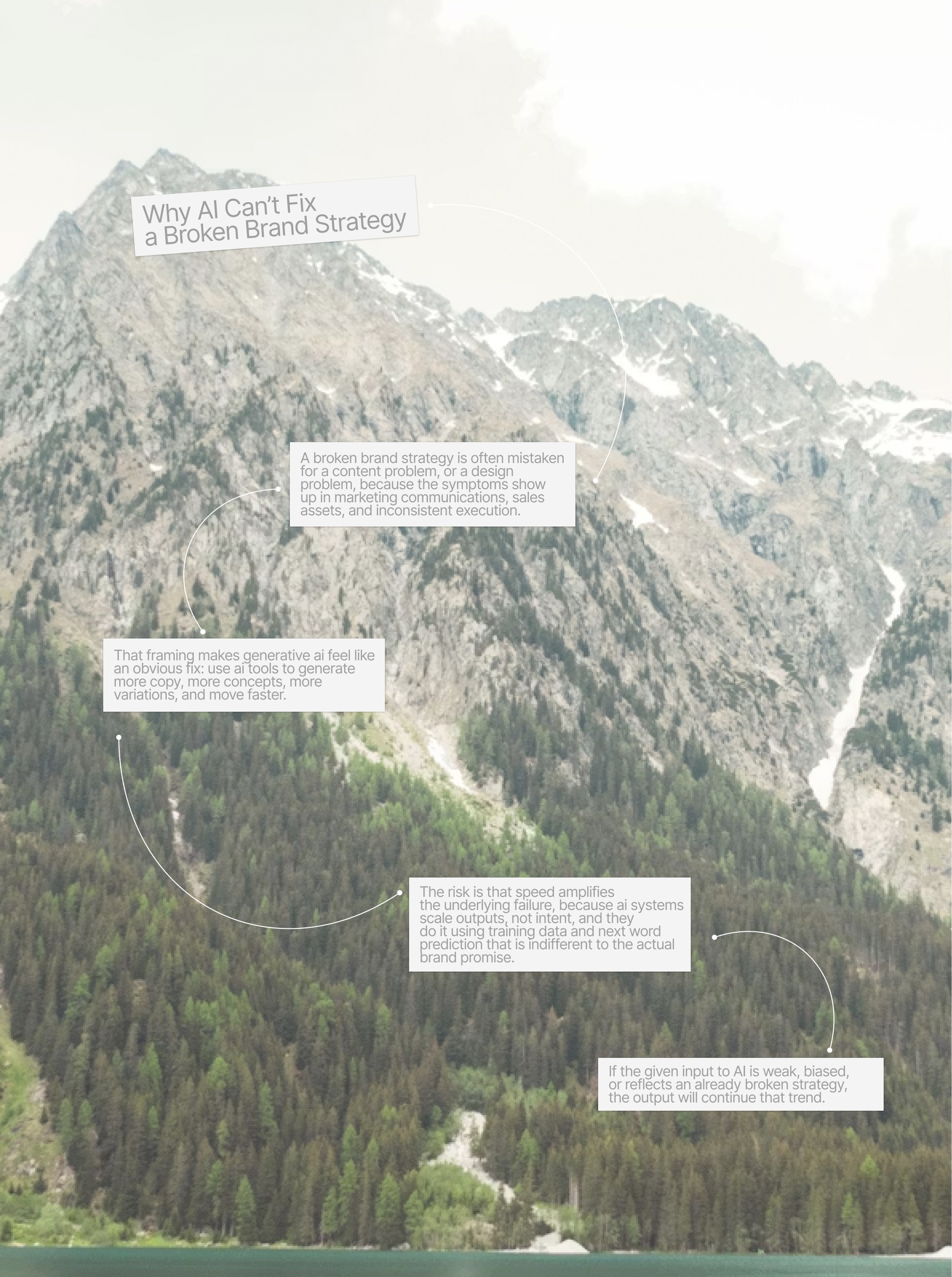
Overreliance on AI therefore creates a specific risk. If every company uses similar models trained on similar market information to identify an "optimal" position, brands can converge around the same apparently rational answers.
The result is efficient sameness.
Nuance, category context, and technical credibility
The problem becomes more serious in B2B, SaaS, deep tech, and other complex technology categories.
Expert buyers notice imprecision quickly. A sentence that sounds credible to a general audience may be technically wrong, exaggerate a capability, or misunderstand why customers actually choose the product.
AI systems can also hallucinate facts, invent supporting statistics, or flatten important distinctions when summarizing complex material. This is why AI assisted content workflows still require subject matter experts and human fact checking.
Branding complex technology requires more than fluent human language. It requires understanding the relationship between:
product capabilities
customer problems
implementation constraints
category dynamics
buyer objections
technical proof
commercial value
A model can help organize this information. It should not be trusted to define the final narrative without human expertise.
Original visual identity vs. generic AI-generated look
AI can create brand assets quickly. Creating a distinctive visual identity is a different problem.
Generative systems work by identifying and recombining patterns. This makes them effective at generating recognizable design directions but also creates a tendency toward familiar aesthetics.
When many companies use similar prompts, models, and templates, outputs can begin to share the same visual vocabulary. The result may be professionally rendered but strategically interchangeable.
This is particularly visible with AI generated logos. An AI logo maker can create a usable logo for a small business quickly, but a complete brand identity requires decisions about typography, color, imagery, motion, composition, hierarchy, and how those elements work together as a brand system.
There are also practical IP concerns. Purely AI generated assets can face limitations around copyright protection, while generated logos or names can unintentionally resemble existing intellectual property.
The larger problem is not simply originality. It is meaning. A visual system becomes distinctive because particular design choices repeatedly express the same strategic idea. AI can imitate the surface of that system. Human designers still need to decide what the system means.
Why AI-only branding is especially risky for technical and B2B companies
For a small consumer project, generic AI generated branding may be sufficient. The risk increases substantially when the company sells a complex product through a long consideration cycle.
B2B customers often encounter the same brand across websites, sales decks, white papers, product interfaces, social media, events, and sales conversations. Different people may also evaluate different parts of the offer.
The brand therefore has to remain coherent while providing different levels of information.
Technical users may need depth. Executives may need strategic value. Procurement may need evidence and risk reduction. Investors may focus on market potential and differentiation.
An AI only branding process tends to optimize individual outputs rather than the relationship between them.
That can create:
inconsistent claims across channels
generic messaging
technical inaccuracies
a weak or unstable brand voice
interchangeable visual assets
fragmented customer experience
This is particularly dangerous in technology markets where functional differentiation can disappear quickly. Lippincott notes that in software, a large share of features can be copied within months, meaning familiarity, trust, and brand affinity increasingly influence customer choice once functional parity emerges.
That is why AI brand strategy cannot simply mean generating positioning statements with a language model. The harder task is creating a coherent point of view that the company can maintain as competitors, products, and customer expectations evolve.
AI can accelerate that work. It cannot supply the conviction behind it.
A practical framework: what to hand to AI vs. what to keep human-led
The useful question is not whether companies should use AI in branding. They already are.
The more useful question is where AI increases leverage without sacrificing quality.
Task | AI-assisted or human-led |
|---|---|
Research | AI assisted. Use AI to collect, summarize, and structure large amounts of information. Keep research questions, source validation, and interpretation human led. |
Competitor scans | AI assisted. Automate collection of positioning, claims, and patterns, then use human judgment to identify meaningful differentiation. |
Naming | AI assisted. Use AI to expand the option set. Keep strategic selection, linguistic checks, and trademark review human led. |
Copywriting | AI assisted. Useful for first drafts, variations, web copy, and social media content. Human review should control accuracy, brand voice, and final quality. |
Moodboards | AI assisted. Use generative AI for rapid visual exploration, then let designers curate and define the final direction. |
Logo and visual identity | Human led. AI can produce references and explorations, but identity needs original creative direction and a coherent system. |
Positioning | Human led. AI can map possibilities but should not make the strategic tradeoffs that define the brand. |
Messaging strategy | Human led. AI can generate content from an established architecture, but the architecture itself requires category and audience judgment. |
Brand guidelines | Human led, AI assisted. Humans establish the rules. AI can help document, check, and apply them across brand assets. |
Launch strategy | Human led. AI can support analysis and content production, but market choices, sequencing, and business priorities require strategic judgment. |
This model also explains how AI can help maintain brand consistency. Once the brand values, voice, visual rules, and approved brand elements are explicit, AI tools can check or generate assets against those constraints.
In other words, AI becomes more useful after the brand has made its important decisions.
How Bolder blends AI speed with strategic judgment
Bolder's public methodology does not position the agency as an automated or AI driven branding service. Instead, its process explicitly starts with positioning and messaging before moving into identity, websites, and ongoing brand execution. The agency describes brand strategy as the foundation for deciding what a company says, why it matters, and how it should communicate across audiences.
That distinction provides a useful model for using AI inside the branding process. AI can accelerate research, organize large amounts of information, generate alternatives, and support production. But the decisions that establish a company's brand values, differentiation, messaging architecture, and visual direction remain human led.
For complex B2B and technology companies, this separation is particularly important. The objective is not to avoid AI. It is to use AI where speed creates value without outsourcing the judgment that makes the brand distinctive.
AI is fast at options. Humans are fast at conviction.
AI Branding Tool Examples
Looka
Looka demonstrates how far automated visual branding can already go. Its AI branding tools can generate logo options from a company name and preferences, then extend a selected direction into colors, fonts, social media assets, and other branded templates. It is an efficient way to create a basic identity quickly, but it also illustrates the difference between generating brand assets and developing a strategically distinctive brand system.
Jasper
Jasper illustrates the production side of AI branding. Its generative AI workflows can create multiple versions of marketing copy and campaign content quickly, helping teams produce more material across channels while following defined brand voice inputs. The important point is that the system works best once those strategic rules already exist. AI accelerates execution, while human teams still define the brand and approve what represents it.
FAQs
Can AI create a full brand identity on its own?
AI can generate logos, colors, typography combinations, templates, and other brand assets. It cannot reliably replace the human led strategy, differentiation, creative direction, and governance required to build a distinctive long term brand identity.
Is AI-generated branding bad for SEO or trust?
Not inherently. AI generated content becomes a trust problem when it introduces factual errors, generic claims, inconsistent brand voice, or low quality content. Human review and clear brand guidelines are essential.
What branding tasks are safe to automate with AI?
Research collection, competitor scans, content summaries, first draft copy, naming exploration, moodboards, and visual ideation are strong candidates for AI assistance. Positioning, messaging strategy, core visual identity, and launch strategy should remain human led.
Will AI replace branding agencies?
AI will automate parts of agency research and production, but it does not eliminate the need for strategic judgment, category expertise, creative direction, and client decision making. The likely shift is toward agencies using AI to work faster while concentrating human expertise on the decisions that create differentiation.

Masha is the founder of Bolder, a branding and communications agency for tech startups in AI, robotics, biotech, deep tech, and energy. She’s built three companies and leads a team of talented strategists and designers, helping technical founders turn hard to explain work into brands sharp enough to match the tech behind them.