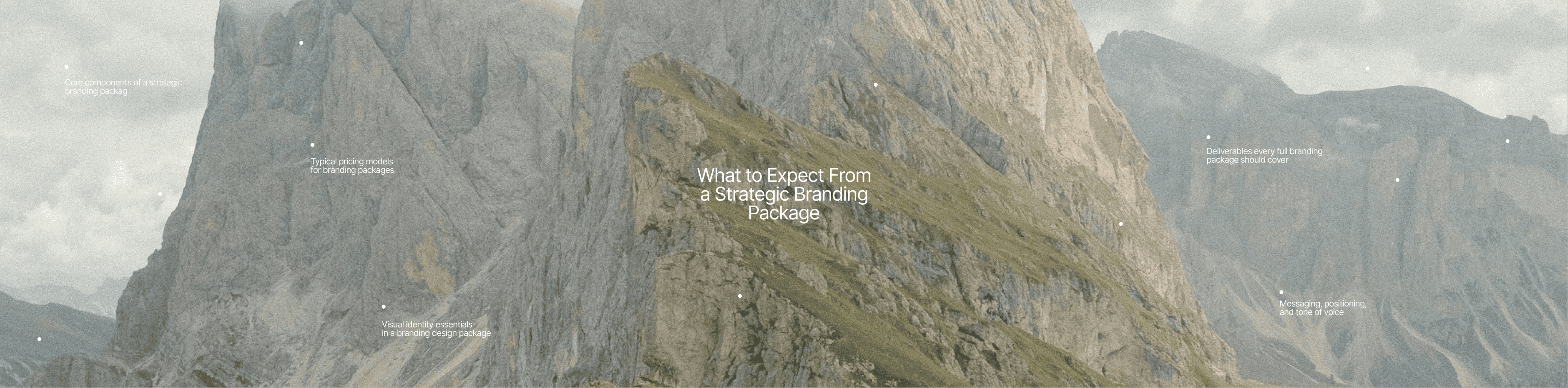

What to Expect From a Strategic Branding Package
What a Branding Package Includes
Core components of a strategic branding package
When companies ask what to expect from a strategic branding package, the answer starts with structure rather than outputs. A full branding package is built as an integrated system that aligns strategy, design, messaging, and governance around a single cohesive brand identity.
At its core, a comprehensive branding package includes brand strategy, brand identity design, verbal systems, and operational frameworks that allow teams to work consistently over time. This typically begins with diagnosing the current brand image, understanding the target audience and target market, and mapping how the company’s branding performs across digital platforms, marketing campaigns, sales interactions, and product touchpoints.
Brand strategy defines the value proposition, brand personality, positioning, and brand message. This framing then informs the brand’s visual identity, including brand colors, font styles, graphic elements, illustration style, and other branding elements. Without this strategic layer, visual assets risk being visually appealing but disconnected from business goals or user expectations.
A strategic branding package also includes governance mechanisms. These ensure proper logo usage, consistent branding, and long term brand recognition as the business evolves. By providing clear brand guidelines or a style guide, these mechanisms help maintain consistency and coherence in the company's branding across all platforms and marketing materials. The result is not just a collection of files, but an operating system for the company’s branding.
Deliverables every full branding package should cover
A full branding package typically includes a defined set of deliverables, each solving a specific internal problem.
A brand strategy document clarifies positioning, target audience, value proposition, and competitive differentiation. This prevents misalignment between leadership, marketing, product, and sales teams.
A brand identity package defines the brand’s aesthetic, including the brand's color palette as a foundational element, through logo design, logo variations, a primary logo, custom logo rules, typography, and layout systems. This supports a strong brand identity that can scale across marketing materials, digital assets, and print assets.
Brand guidelines or a brand style guide document how branding elements should be used. These brand guidelines include rules for logo placement, color palette usage, font hierarchy, and visual elements across channels. This reduces dependency on individual designers and ensures work stays on brand even when external partners or web developers are involved.
A brand kit or brand assets library often includes ready to use templates for business cards, social media graphics, sales decks, and other promotional materials. These templates allow the internal team to produce marketing materials efficiently while maintaining consistent branding.
A branding package serves as a toolkit that ensures consistency across all customer touchpoints.
Together, these deliverables form a complete branding package that supports execution rather than just presentation.
Difference between branding package includes vs. à la carte services
The difference between branding package includes and à la carte branding services is systemic.
Business branding packages are designed as integrated systems. Strategy informs design, design informs messaging, and governance ensures consistency across teams and time. Each component reinforces the others.
À la carte services focus on isolated outputs such as a well designed logo, packaging design, or a refreshed website. While these may look polished, they often lack alignment with broader brand strategy or brand voice. Over time, this creates fragmented brand identity, duplicated work, and inconsistent brand recognition.
A comprehensive branding package reduces these risks by treating branding as infrastructure rather than decoration. It creates reusable frameworks that lower long term costs, even if the branding package cost is higher upfront. With a strategic branding package, you get just that: all the essential elements for a cohesive brand identity, without unnecessary extras.
Understanding Branding and Design Services Within a Package
Role of brand strategy in comprehensive branding packages
Brand strategy acts as the constraint system for all branding and design services. It defines who the brand is for, what problem it solves, and why it matters in the market.
In B2B and technology contexts, where buying decisions involve multiple stakeholders, brand strategy clarifies which audiences matter most and how the company should be positioned. This prevents teams from optimizing only for short term metrics or surface level aesthetics.
Without brand strategy, brand design decisions become subjective. With strategy in place, visual identity, brand voice, and messaging can be evaluated against clear criteria. This improves alignment across marketing campaigns, sales enablement, and product communication.
Visual identity essentials in a branding design package
A branding design package treats visual identity as a system rather than a collection of files. The brand’s visual identity typically includes logo design, logo variations, brand colors, typography, layout principles, graphic design elements, and illustration style.
For digital first companies, visual identity increasingly extends into design systems that govern digital assets across websites, products, and social media. These systems ensure the brand identity design is applied consistently across interfaces and screen sizes.
Consistency is critical for brand recognition. Repeated use of a defined brand style, brand’s color palette, and visual assets creates familiarity and trust. This is enforced through systems and guidelines rather than relying on individual designers’ judgment.
Messaging, positioning, and tone of voice
Messaging frameworks translate brand strategy into operational language. They define the core brand message, supporting proof points, and how the message adapts across contexts such as websites, sales decks, social media, and other promotional materials.
Tone of voice guidelines describe how the brand sounds across channels. They help teams maintain a consistent brand personality while allowing flexibility based on context, whether formal documentation or customer facing interfaces.
Together, positioning and brand voice act as filters. They help teams decide what fits the company’s branding and what does not, supporting long term consistency as the business grows.
Brand Identity Design Process
The brand identity design process is a structured approach to building a comprehensive branding package that captures the essence of your business. This process ensures that every aspect of your brand—from your logo to your color palette and beyond—works together to create a cohesive and memorable visual identity. A comprehensive branding package typically includes not just the visual elements, but also the brand guidelines that govern their use, ensuring consistency across all platforms and materials.
By following a strategic brand identity design process, businesses can develop a brand that not only looks great but also aligns with their values, speaks to their target audience, and supports their long-term goals. This process is essential for creating a brand that stands out and remains relevant as your business evolves.
How Branding Package Pricing Works
Typical pricing models for branding packages
Branding package pricing varies based on engagement structure. Common models include fixed scope projects, tiered packages, and hybrid approaches that combine an initial project with ongoing support.
Fixed scope branding packages define deliverables and timelines upfront. Tiered models offer options ranging from a basic package to a complete branding package with deeper strategy and implementation. Retainer models support continuous evolution of brand assets as the company’s branding needs change.
Each model reflects different assumptions about scope stability, internal capability, and speed of change.
What affects branding package pricing (scope, depth, customisation)
Several factors influence branding package cost. Scope is a major driver. Covering more touchpoints such as digital platforms, marketing materials, product interfaces, and social media increases complexity.
Depth of research also matters. Branding packages that include customer research, stakeholder alignment, and competitive analysis require more effort but reduce strategic risk.
Customization further affects pricing. A custom brand package that includes bespoke design systems, unique visual identity components, and governance frameworks costs more upfront but often lowers long term execution costs.
Organizational complexity also plays a role. Multiple stakeholders, regions, or legacy systems increase the effort required to align and implement the brand effectively.
Comparing fixed vs. custom branding packages
Fixed branding packages offer predictability. They work well for companies with straightforward needs and limited internal complexity.
Custom branding packages adapt to the company’s branding maturity, internal team capabilities, and growth plans. They allow phased delivery and deeper integration with product and marketing workflows.
The choice depends less on company size and more on structural complexity, existing brand assets, and the desired level of long term scalability.
How to Choose the Right Branding Package for Your Business
Assessing business needs before selecting a package
Choosing the right branding package requires an honest assessment of business needs. Companies should evaluate where brand inconsistency appears, whether in marketing materials, digital assets, or customer interactions.
Understanding the target audience, growth model, and internal design team capacity helps determine whether a basic package is sufficient or whether a full branding package is required.
Clarifying time horizons is also important. Some businesses need a minimal system quickly, others can invest in deeper strategic foundations.
Startup branding vs. enterprise branding packages
Startup branding packages often focus on speed and clarity. They prioritize sharp positioning, a strong brand identity, and flexible systems that can adapt as the business evolves.
Enterprise branding packages emphasize governance, scalability, and integration across products, regions, and teams. Corporate identity packages at this level address brand architecture, complex brand assets, and long term brand management.
The key distinction is not company age but operational complexity and risk tolerance.
Questions to ask before investing in a full branding package
Before committing to a full branding package, companies should ask what business success metrics the branding is expected to support. They should clarify which branding elements matter most now and which can follow later.
It is also critical to define ownership. Someone internally must be responsible for maintaining the brand system after delivery. Without this, even well built branding services lose effectiveness over time.
Common Misconceptions About Branding Packages
Branding isn’t just logos and colours
Many still equate branding with logo design and color palette selection. This persists because visual changes are immediately visible, while strategy and governance work are less obvious.
In reality, strong brand identity depends on aligned strategy, messaging, visual systems, and operational rules. Logos and colors are only one layer of a much broader system.
Why cheaper isn’t always better
Lower cost branding options often reduce research, strategy, and governance. While the outputs may look polished, they frequently fail to support consistent execution as the company grows.
Over time, this leads to repeated redesigns, fragmented brand assets, and inefficiencies that outweigh the initial savings. In this sense, branding package cost should be evaluated against long term operational impact, not just upfront fees.
The value of strategy-led branding packages
Strategy led branding packages create alignment across teams, reduce execution friction, and support consistent brand recognition. They function as long term infrastructure rather than short term creative projects.
By investing in systems such as brand guidelines, design systems, and messaging frameworks, companies create assets that compound in value as the business scales.
Branding Package Examples
At this stage, here are a few examples of strategic branding packages that illustrate how different brands approach cohesive identity and consistency:
• Sungrown: Designed for a cannabis dispensary, this branding package incorporates nature-inspired elements throughout its visual identity.
• Haystack: Features a color palette with secondary colors and provides examples of visually appealing color combinations.
• AWSM Sauce: Emphasizes sustainability and includes brand identity, packaging, illustration, and a custom icon system.
• Happy Tooth: Offers an expanded color palette, four signature fonts, and a complete logo system.

• My Next Season: Showcases a simpler, modern logo design that reflects the company’s perspective on career transitions as seasonal changes.
• Oda Candles: Includes a detailed color palette reflected in each candle’s label and uses typefaces that promote relaxation and eco-friendliness.
• Spotify: The brand kit includes colors, fonts, icons, and logo usage guidelines to ensure brand consistency.
• Water Lily Pops: Features a new logo, mobile-optimized website design, and packaging that creates a seamless experience across digital and physical touchpoints.
• Kosan Gas: Noted for its simplicity and harmonious look, maintaining consistency across various assets.
• Mareiner Holz: Reflects a sustainable identity with subdued colors and a calm, cohesive concept.
• Internationale Spieltage SPIEL: Showcases a colorful and vibrant branding package with a clean and straightforward design.
• Tavares Duayer Arquitetura: Features a coherent color palette that complements its architectural identity.
Intercom
Intercom’s branding reflects the logic of a full branding package rather than a collection of visual assets. A clearly articulated brand strategy, structured brand message, and governed brand identity system allow product, marketing, and content teams to operate independently while maintaining consistent branding. Brand guidelines and a centralized brand kit make it possible to roll out new marketing materials and digital assets without reinterpreting the brand each time.
Stripe
Stripe demonstrates how a comprehensive branding package supports complexity over time. Its brand identity package combines a restrained visual identity, precise brand voice, and strict usage rules that scale across products, developer documentation, and global marketing campaigns. The strength of the system lies not in decoration, but in how brand assets, visual elements, and messaging frameworks enable consistent execution across teams and partners as the business evolves.
FAQs
What does a branding package typically include?
A branding package typically includes brand strategy, brand identity design, brand guidelines, visual assets, messaging frameworks, and core marketing materials.
How is branding package pricing determined?
Branding package pricing depends on scope, research depth, customization, and organizational complexity.
What’s the difference between a branding design package and a full branding package?
A branding design package focuses on visual identity, while a full branding package includes strategy, messaging, governance, and implementation systems.
How long does a strategic branding package usually take?
Timelines vary, but most strategic branding packages take several weeks to a few months depending on scope.
Do branding packages include implementation support?
Some do. Comprehensive packages often include rollout guidance, templates, and training, while others focus on strategy and assets only.