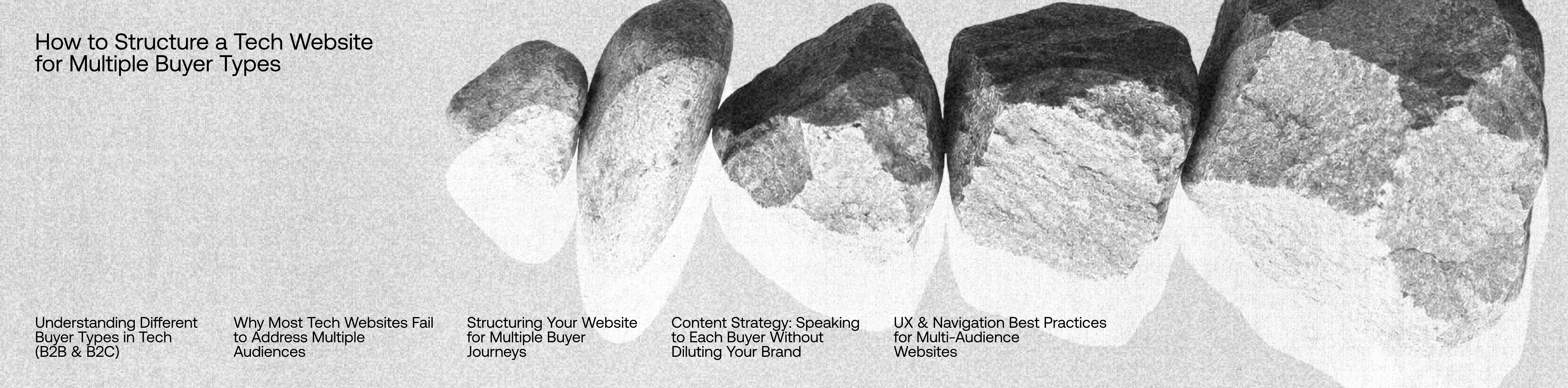
How to Structure a Tech Website for Multiple Buyer Types
Tech companies rarely serve a single target audience. Even in relatively simple products, multiple buyer personas interact with the website, each with different goals, levels of expertise, and evaluation criteria. In B2B environments, this complexity increases significantly because the buying process typically involves multiple stakeholders, including decision makers, technical evaluators, end users, and procurement.
Each of these groups represents a different layer of intent. Enterprise buyers focus on business outcomes, risk, and scalability. Technical users prioritize technical specifications, integrations, and implementation details. End users are more concerned with usability and day to day value. These differences shape how buyers evaluate information and what they expect to see across product and solution pages.
In B2C or ecommerce websites, the structure is usually optimized for individual decision making. In contrast, a B2B website design must support group decision dynamics, where different stakeholders enter the site at different points in the buyer’s journey. This means the same website must serve discovery, evaluation, and validation simultaneously.
As a result, designing for multiple audiences is not about listing features for everyone on the same page. It requires mapping relevant journeys for different personas and aligning content with their specific pain points. Without this, the site becomes a static brochure that generates traffic but fails to convert potential customers into qualified leads.
Why Most Tech Websites Fail to Address Multiple Audiences
Most tech websites fail because they try to compress all audiences into a single narrative. Instead of structuring around user needs, they structure around the company’s internal view of the product. This leads to generic messaging that does not speak directly to any specific persona.
A common issue is the absence of clear segmentation. When multiple personas are forced through the same page without guidance, users must self interpret relevance. This increases cognitive load and reduces user engagement, especially when visitors cannot quickly find content aligned with their role in the sales funnel.
Another structural problem is over reliance on surface level content. Many sites prioritize top level messaging but fail to provide deeper layers such as comparison pages, detailed documentation, or role specific use cases. For technical buyers, this creates friction. For decision makers, it reduces confidence.
Navigation also contributes to failure. When site structure is not designed around different stakeholders, users encounter dead ends or irrelevant paths. This leads to lower conversion rate, fewer demo requests, and reduced form submissions.
There is a clear cause and effect pattern. Lack of segmentation leads to unclear navigation. Unclear navigation increases friction. Increased friction reduces conversion rate optimization performance and weakens lead generation.
In many cases, the result is high website traffic but low conversion into paying customers.
Structuring Your Website for Multiple Buyer Journeys
A strong B2B tech website structure organizes content around how different personas move through the buyer’s journey, rather than around internal product categories alone.
One common approach is to create layered pathways. At the top level, the website presents a unified value proposition through core solution pages. These pages communicate what the product does and who it is for. From there, users can branch into more specific paths based on role, industry, or use case.
Segmentation can be implemented through multiple entry points. Role based navigation helps different personas quickly find relevant content. Industry pages address context specific needs. Use case pages connect features to concrete outcomes. These pathways ensure that each persona can access information aligned with their priorities.
The balance between unified and segmented content is critical. Not every audience requires separate landing pages. In some cases, a single page with structured sections can serve multiple personas effectively. However, high intent pages such as pricing page, demo flows, and key solution pages often require more targeted content to support conversion.
Effective structure also supports product led growth. Clear navigation to product pages, documentation, and demo form reduces friction and enables users to explore the product independently before engaging with the sales team.
The objective is not to duplicate content for each persona but to create a system where users can quickly navigate to what is relevant. This reduces friction, improves conversion rate, and increases the likelihood of generating qualified leads.
Content Strategy: Speaking to Each Buyer Without Diluting Your Brand
Content strategy for multi audience website design requires balancing specificity with coherence. The core challenge is to address different personas without fragmenting the brand or creating inconsistent messaging.
A layered messaging model helps solve this. At the top level, the website communicates a clear and concise value proposition that applies across audiences. This establishes a shared understanding of what the product offers. Below this layer, content adapts to specific personas by addressing their unique pain points and priorities.
For example, decision makers may need content focused on ROI and business outcomes, while technical users require deep documentation and implementation clarity. Both layers must exist within the same system, but they should not compete for attention on the same level.
Consistency is critical. A unified tone and structure ensure that even as content adapts, the brand still feels coherent. This includes alignment across content marketing, product messaging, and sales materials. Without this, the experience becomes fragmented and reduces trust.
Content should also support different stages of intent. Early stage users need high level explanations. Mid stage users look for validation such as social proof, client logos, and case studies. High intent users require specific details that support demo requests and decision making.
When structured correctly, content allows the website to speak directly to different personas while still feeling like a single, consistent system.
UX & Navigation Best Practices for Multi-Audience Websites
UX and navigation determine whether users can move efficiently through the site. For tech website navigation best practices, the primary objective is to reduce friction while supporting multiple buyer personas.
Information architecture should reflect user intent rather than internal organization. Navigation labels must be clear and aligned with how users think about the product. This helps visitors quickly identify relevant sections without scanning the entire site.
Progressive disclosure is a key principle. Instead of presenting all information at once, the site reveals detail gradually. High level pages introduce the product, while deeper pages provide technical detail and supporting content. This structure accommodates both non technical and technical users without overwhelming either group.
Search functionality also plays an important role, especially for complex products with large amounts of relevant content. A strong search function allows users to bypass navigation and directly access what they need.
Performance and accessibility affect perception and conversion. Fast load times, optimized experiences on mobile devices, and digital accessibility standards contribute to lower friction and higher user engagement.
UX decisions directly influence outcomes. Clear navigation increases time on site. Reduced friction improves form submissions. Better alignment between user intent and content increases conversion rate and supports lead generation.
How Branding Aligns Different Buyer Types into One Cohesive Experience
When multiple personas interact with the same website, branding acts as the unifying system that holds the experience together. Without strong brand structure, segmentation can quickly turn into fragmentation.
Branding defines the core narrative that connects all website audiences. A clear positioning ensures that regardless of which path users take, they encounter a consistent explanation of the product and its value. This reduces confusion and strengthens trust signals across the site.
Visual and verbal consistency also play a critical role. A coherent user interface, aligned tone of voice, and consistent design patterns ensure that different pages feel connected. This is especially important when users move between product pages, solution pages, and supporting content.
Brand systems also support scalability. As companies add new products, enter new markets, or introduce emerging trends such as AI or machine learning, a strong brand foundation ensures that new content integrates naturally into the existing structure.
From an operational perspective, branding improves operational efficiency. Teams can produce content faster because they work within defined systems. This reduces inconsistencies and supports continuous iteration through data collection and continuous improvement.
Ultimately, branding allows a complex website to feel simple. It ensures that even with multiple buyer journeys, the experience remains coherent, intuitive, and aligned with the company’s strategic direction.
Examples
Stripe
Stripe structures its website around different developer and business audiences without fragmentation. It combines high level messaging with deep technical documentation, allowing both decision makers and engineers to navigate efficiently within the same system.
HubSpot
HubSpot uses segmented pathways based on product, role, and business size. Its navigation and content layers guide different personas through tailored journeys while maintaining a consistent brand and unified value proposition.
FAQs
How do you design a website for multiple buyer personas?
By structuring navigation and content around distinct user journeys, while maintaining a unified value proposition and consistent brand system.
What is the best website structure for SaaS companies?
A layered structure with core solution pages, role or use case segmentation, and clear paths to high intent pages such as pricing and demos.
How can a tech website target both technical and non technical users?
Through progressive disclosure, combining high level messaging with deeper technical content accessible through structured navigation.
Should I create separate landing pages for each audience type?
Only when intent differs significantly, otherwise structured pages with segmented sections can be more efficient.
How does UX impact conversions for different buyer journeys?
UX reduces friction, improves navigation clarity, and aligns content with user intent, which increases engagement and conversion rates.

Masha is the founder of Bolder, a branding and communications agency for tech startups in AI, robotics, biotech, deep tech, and energy. She’s built three companies and leads a team of talented strategists and designers, helping technical founders turn hard to explain work into brands sharp enough to match the tech behind them.