
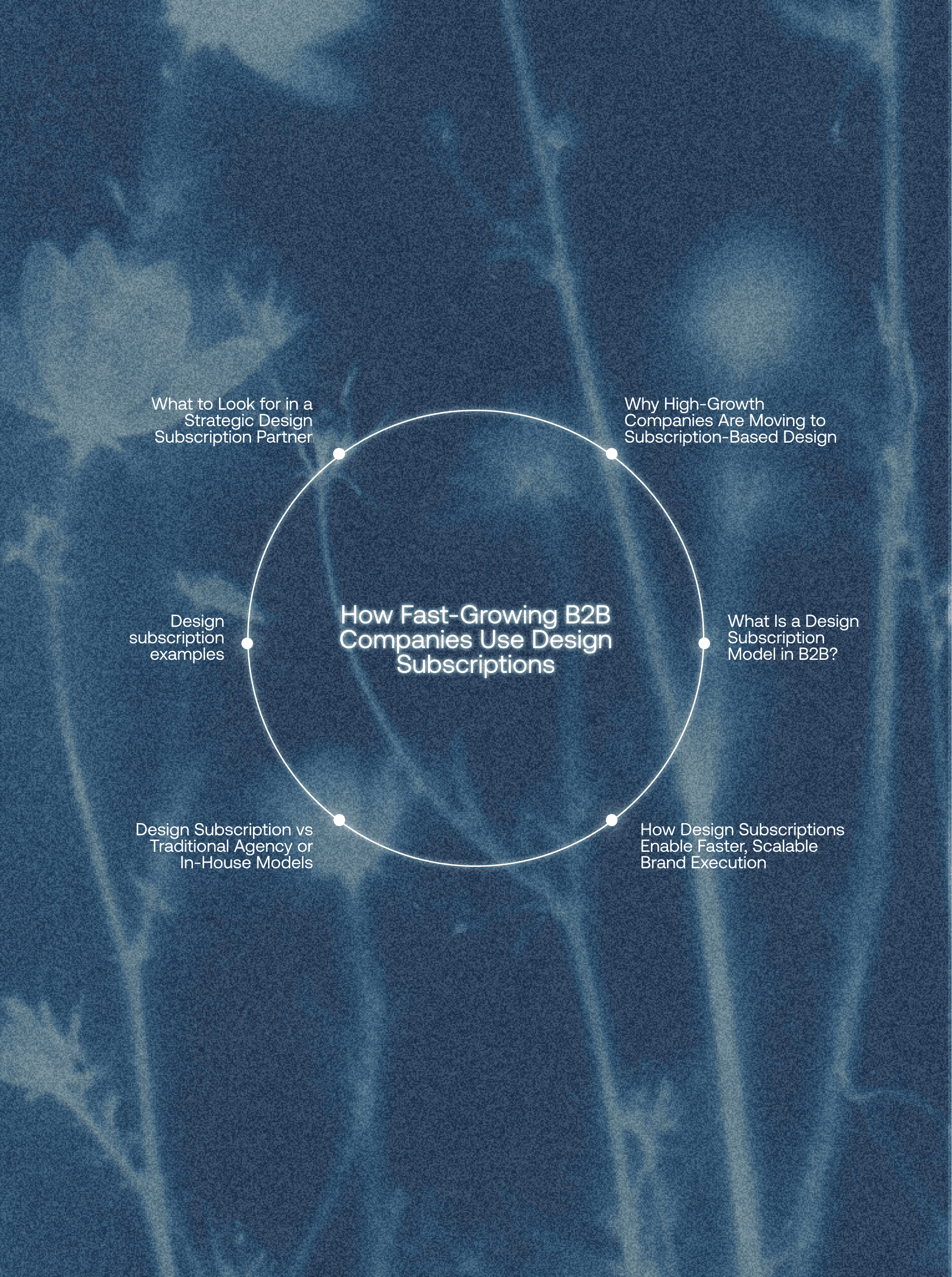
How Fast-Growing B2B Companies Use Design Subscriptions
Fast-growing B2B companies face a structural challenge: demand for design work increases much faster than internal teams can scale. Marketing campaigns, product launches, landing pages, sales materials, product documentation, and social media graphics all require continuous creative production. As companies expand into new markets and channels, graphic design, video design, and motion design needs multiply.
This is the context behind the growing interest in how fast growing B2B companies use design subscriptions to sustain creative output without constantly expanding internal teams.
Design demand is not only growing in volume but also in complexity. Companies must produce graphic and video design, presentation design, document design, landing pages, and web design for multiple audiences and channels. For marketing teams working in high-volume environments such as SaaS, fintech, or e-commerce, maintaining consistent brand quality while delivering fast turnaround becomes a serious operational constraint.
A design subscription addresses this challenge by providing continuous access to professional design services through a subscription based model. Instead of hiring additional designers or commissioning isolated projects from agencies, companies work with design subscription services that provide an ongoing creative capacity through a flat monthly fee.
With a subscription model, businesses submit design requests whenever needed. The service provider then delivers assets in sequence or parallel depending on the plan. Many services allow unlimited graphic design requests, meaning companies can continuously queue design work without negotiating a new contract for each project.
For fast-growing companies, this becomes a no brainer operational decision. A predictable monthly structure simplifies budgeting, while a flat monthly fee eliminates unexpected project costs. Instead of managing freelancers or navigating agency retainers, companies gain access to monthly design services that operate as a long-term extension of their internal marketing teams.
These subscription services also improve operational speed. Many best design subscription services deliver first drafts within 24–48 hours, dramatically improving turnaround times compared with traditional agencies. Fast delivery allows marketing teams to move quickly across campaigns, landing pages, and product announcements.
Another advantage is scalability. Companies can scale subscriptions up or down depending on campaign cycles or seasonal demand. This flexibility is particularly valuable for enterprise teams, SaaS businesses, and small businesses that experience fluctuating marketing demand.
The global design industry is expanding rapidly as well. The graphic design market was valued at roughly $57.5 billion in 2023 and is projected to reach more than $78 billion by 2030. As the market grows, more organizations are turning to design subscription services to maintain creative output while controlling operational complexity.
Importantly, subscription designers do not only produce visual assets. They contribute directly to business outcomes. High-quality graphic design services can influence consumer behavior, improve conversion rates on landing pages, and enhance the user experience of digital products. Designers in subscription environments increasingly act as strategic collaborators rather than isolated production resources.
As a result, design subscriptions are becoming a core component of the modern marketing infrastructure for high-growth companies.
What Is a Design Subscription Model in B2B?
A design subscription model provides companies with ongoing access to professional design capabilities through recurring billing. Instead of paying per project, organizations receive continuous creative support through predictable billing cycles.
This subscription based structure is widely considered a practical alternative to hiring freelancers or maintaining large agency retainers. Companies gain reliable access to graphic design services, web development, video design, and motion design without the overhead costs of maintaining a large internal design team.
Most design subscription services operate through a structured design process. Clients submit design requests through a dashboard or project management system. These requests are then completed by the assigned creative team according to defined turnaround times.
Many providers assign each client a dedicated graphic designer or even a small team including a creative director and a dedicated project manager. This structure ensures that designers develop a deep understanding of the client’s brand identity, communication style, and business needs over time.
Having an own dedicated graphic designer offers a significant operational advantage. Instead of repeatedly onboarding new freelancers or agencies, companies work with a dedicated designer who understands their visual system, tone of voice, and marketing goals. This familiarity improves efficiency and allows designers to deliver final design outputs faster.
Most subscription services also include features such as:
Unlimited design requests
Unlimited revisions
Transparent pricing
Clearly defined subscription tiers
Predictable billing cycles
The ability to offer unlimited revisions is particularly valuable. Marketing teams often need multiple iterations before arriving at a final design, especially for landing pages, presentation design, and social media assets.
Another advantage is the broad range of supported deliverables. A typical design subscription may include:
Graphic design
Social media graphics
Web design
Landing pages
Presentation design
Document design
Video editing
Motion design
Large scale printables such as banners or event materials
This versatility allows companies to consolidate most of their design projects under a single service provider.
The best design subscription services also emphasize operational transparency. Dashboards allow teams to track request status, manage revisions, and monitor turnaround times. This structure creates streamlined workflows for marketing teams that depend on fast creative execution.
In practical terms, a design subscription transforms design into an always-available operational resource rather than a separate project-based function.
Why High-Growth Companies Are Moving to Subscription-Based Design
High-growth companies face constant pressure to produce new marketing materials, product visuals, and communication assets. Teams working across social media, websites, email marketing, and product launches must generate a continuous stream of creative output.
Traditional creative models struggle to support this pace.
Agencies typically require detailed project scoping before beginning work, and the process can take weeks before the first drafts are delivered. Meanwhile, building internal teams is often resource intensive, requiring recruitment, onboarding, and ongoing management.
A design subscription solves these operational constraints by providing flexible creative capacity.
Fast-growing B2B companies use subscription based design services to maintain a steady flow of design work across multiple channels. With a predictable monthly structure, companies can maintain consistent creative production without renegotiating project contracts.
Many organizations integrate subscription design directly into their operational infrastructure. Marketing teams often connect their subscription service to collaboration tools such as Slack or Trello, enabling faster communication and quicker turnaround times.
These integrated systems support high volume creative production. Companies can submit new design requests daily, enabling rapid iteration across campaigns and landing pages.
This approach is especially common in industries such as:
SaaS
fintech
e-commerce
digital marketplaces
B2B software platforms
These businesses rely heavily on landing pages, presentation materials, product visuals, and educational content to acquire and retain customers.
Another reason companies adopt subscription design is brand consistency. As organizations expand into multiple channels, maintaining a unified visual identity becomes more complex. A consistent design system across social media, websites, documents, and marketing assets strengthens brand recognition and builds trust with potential customers.
Design subscriptions help address this challenge. When the same design partner produces assets across multiple channels, the resulting visual language becomes more coherent.
Companies can also scale their subscription up or down depending on campaign cycles. For example, during product launches or major marketing campaigns, companies may upgrade to larger plans with additional designers. During quieter periods, they can reduce their subscription tier.
This flexibility makes design subscriptions a practical solution for both enterprise teams and small businesses navigating unpredictable marketing demand.
For organizations operating in rapidly expanding regions such as Latin America or Southeast Asia, the ability to maintain consistent design output across international markets is especially valuable.
How Design Subscriptions Enable Faster, Scalable Brand Execution
Speed is one of the most important advantages of subscription design services.
Many design subscription services promise fast turnaround and fast delivery, with first drafts delivered within 24 to 48 hours. This speed allows marketing teams to move quickly when launching campaigns or responding to market opportunities.
In traditional agency relationships, even small design projects can require multiple rounds of approvals before work begins. With subscription models, companies simply submit new design requests, and designers begin work immediately.
This structure supports streamlined workflows across marketing teams. Campaign assets, landing pages, and social media graphics can be produced quickly without interrupting broader marketing operations.
Continuous collaboration also improves creative quality. Over time, a dedicated graphic designer or creative team develops a deep understanding of the brand’s visual identity and communication style.
This familiarity enables designers to produce final design outputs that align closely with marketing goals.
Design subscriptions also support experimentation. Companies can rapidly test different creative concepts, layouts, and messaging variations across campaigns. Designers can iterate quickly, refining visuals based on performance metrics and audience feedback.
In many cases, subscription designers function as a long-term creative partner rather than simply a production vendor. They collaborate with internal teams on strategy, campaign concepts, and brand development.
This evolving relationship transforms the subscription service into an extension of the internal marketing team.
Design Subscription vs Traditional Agency or In-House Models
Design subscription services occupy a middle ground between traditional agencies and internal design teams.
Agencies typically focus on large strategic projects such as brand identity development, campaign concepts, or product launches. While they provide valuable expertise, their project-based structure often limits flexibility.
Internal teams provide deep organizational knowledge but are constrained by headcount. Expanding internal teams can be expensive and time consuming.
A design subscription provides a hybrid alternative.
With transparent pricing and predictable billing cycles, companies gain ongoing access to professional design capabilities without expanding internal teams. Many providers also offer custom packages that allow businesses to tailor the service to their specific needs.
For companies producing high volume marketing assets, this structure offers clear advantages. Instead of hiring additional designers, organizations can rely on subscription services to manage ongoing creative output.
This model is particularly effective for enterprise teams that require continuous creative support but prefer not to maintain large internal design departments.
The best design subscription services offer multiple subscription tiers. Companies typically start with a standard package and upgrade as their creative needs expand.
This tiered structure allows businesses to maintain cost effectiveness while ensuring access to professional design capabilities when needed.
For many companies, this flexibility makes subscription design a solid choice compared with traditional agency retainers or ad-hoc freelance hiring.
What to Look for in a Strategic Design Subscription Partner
Not all design subscription providers deliver the same level of value. Companies should evaluate potential partners based on several key factors.
The first factor is the range of design capabilities offered. The most effective providers support a broad range of deliverables, including:
graphic design
web design
motion design
video editing
presentation design
document design
landing pages
large scale printables
The second factor is operational transparency. The best design subscription services provide dashboards that allow teams to monitor design requests, track progress, and manage unlimited revisions.
Some providers also limit creatives by restricting the number of concurrent requests or designers assigned to a project. Companies should carefully evaluate whether these limits align with their operational needs.
Another important factor is communication. Many subscription services assign a dedicated project manager who coordinates the design process, ensures quality control, and manages communication between designers and clients.
Strong communication improves efficiency and helps ensure the final design aligns with business objectives.
Pricing is also a critical consideration. Reliable providers emphasize transparent pricing, allowing companies to clearly understand what services are included within each plan.
Finally, organizations should consider whether the service can act as a long-term design partner. The most effective providers invest time in developing a deep understanding of the client’s brand, audience, and strategic goals.
This strategic alignment transforms the service from a simple production resource into a true creative partner that contributes to long-term brand growth.
Design subscription examples
Several companies illustrate how design subscription services operate in practice.
Design Pickle is one of the most widely known subscription design providers. The service offers a wide range of creative capabilities including graphic design, presentation design, motion design, and marketing visuals.
Another example is Superside, which has built a reputation for fast delivery and high-quality creative output. Superside’s model focuses on supporting companies that require high volume design production while maintaining strong brand consistency.
Designjoy, launched in 2017, operates entirely through a subscription based model. It provides unlimited design requests for a flat monthly fee and has become popular among startups and technology companies.
ManyPixels offers structured subscription tiers and assigns each client a dedicated project manager to ensure quality control before designs are delivered.
Penji is known for offering affordable design subscriptions and even supports nonprofit organizations with specialized pricing programs.
Another provider, No Limit Creatives, has completed more than one million designs for major brands across multiple industries.
These companies demonstrate the endless possibilities of subscription design. By combining scalable creative capacity with predictable pricing, subscription services enable organizations to maintain consistent visual communication across campaigns and platforms.
FAQs
What types of companies use design subscriptions?
Design subscriptions are commonly used by SaaS companies, technology startups, marketing teams, and small businesses that require continuous design production across social media, websites, and marketing campaigns.
Are design subscriptions cost-effective for scaling teams?
Yes. Predictable pricing and scalable subscription tiers allow companies to maintain ongoing creative capacity while controlling operational costs.
How do subscription design services improve speed and consistency?
Centralized request systems, dedicated designers, and clearly defined turnaround times enable teams to produce creative assets faster while maintaining consistent brand quality.
Can design subscriptions support brand consistency?
Yes. Continuous collaboration allows designers to build a deep understanding of the brand, ensuring consistent execution across marketing channels and digital platforms.

Masha is the founder of Bolder, a branding and communications agency for tech startups in AI, robotics, biotech, deep tech, and energy. She’s built three companies and leads a team of talented strategists and designers, helping technical founders turn hard to explain work into brands sharp enough to match the tech behind them.