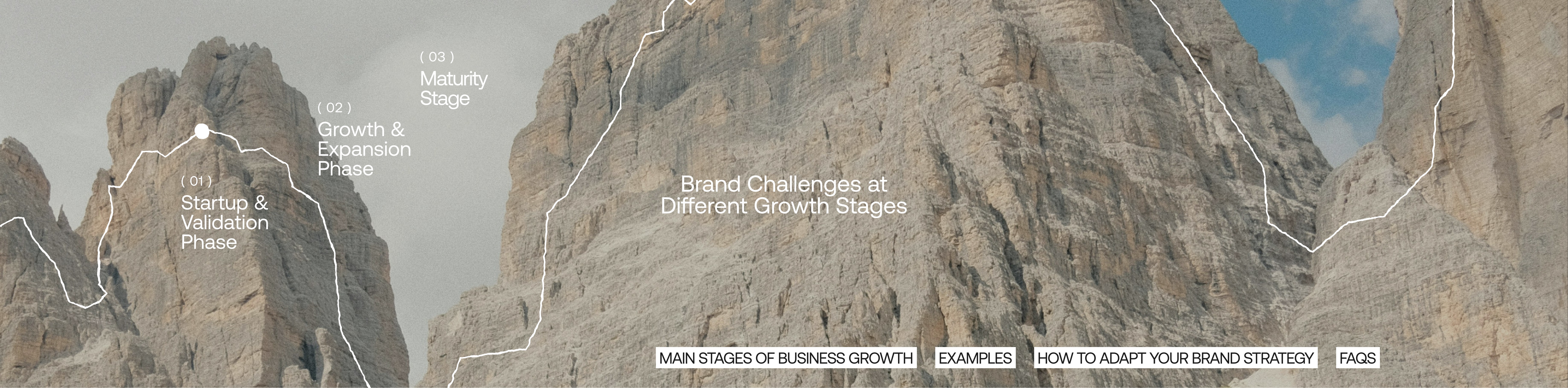

Brand Challenges at Different Growth Stages of Business Growth
Most companies move through a recognizable business life cycle, even if the exact timeline varies by industry or business model. Strategy and management frameworks typically describe several stages of business growth, beginning with the startup stage, progressing through a growth or expansion stage, and eventually reaching a maturity stage. Each phase reflects a different balance of risk, operational complexity, and market presence.
At the beginning of the business journey, organizations focus on validating a business idea and proving that a viable business model exists. This stage usually involves intensive market research, early product iterations, and a narrow target market. Teams are small, often funded by personal savings, and the primary objective is to confirm that the product solves a real problem for identifiable customer needs. Understanding small business growth and its stages is crucial for effectively scaling from a startup to a larger enterprise.
Once demand becomes predictable, companies enter the growth phase. Revenue increases, teams expand, and the company starts pushing for broader market penetration. At this point the business begins building repeatable sales strategies, expanding marketing efforts, and investing in operational systems that enable rapid growth. The competitive landscape becomes more visible, and maintaining operational efficiency becomes critical. Investing in scalable systems at this stage is essential to streamline operations and enhance customer service.
Eventually the organization reaches the maturity stage, when the business matures and growth slows compared with earlier phases. Market saturation leads to plateauing sales and increases competition, often resulting in potential price wars that erode margins. Mature businesses usually operate across multiple existing markets, manage complex brand portfolios, and focus on defending market share, improving profit margins, and sustaining customer satisfaction. Maintaining market share becomes a priority, requiring strategies for retaining customers and optimizing operations to stay competitive. Strategic decisions often involve entering new markets, evolving the business strategy, or introducing new business models to foster growth.
From a branding perspective, these stages of business growth produce different types of brand challenges at different growth stages. In early phases, branding focuses on positioning clarity and credibility. During the expansion stage, the central problem becomes scaling brand identity while maintaining consistency. In mature companies, branding evolves into a strategic infrastructure that supports brand portfolio strategy, integrated marketing communication, and long term relevance. Rapid innovation can cause businesses to cycle back through growth stages or pivot quickly in response to new market insights or technological advancements.
Branding therefore operates differently across the business growth cycle branding process. Early on it supports discovery and validation. In growth stages it supports scale and coordination. In mature organizations it becomes an operational system that aligns strategy, communication, and product portfolios. Cash flow is critical at every stage for maintaining operations, addressing issues promptly, and supporting expansion strategies such as market penetration, product development, or mergers and acquisitions.
Strategic decision-making must be both flexible and deliberate, incorporating real-time data and forecasting to anticipate market shifts.
Early Stage Branding Challenges (Startup & Validation Phase)
The startup phase presents a distinct set of branding challenges for startups, especially in B2B and technology markets where credibility and differentiation matter from the beginning. Early companies are still validating their business idea, defining their target market, and refining the product. As a result, the brand often evolves alongside the product itself.
One of the most common challenges in the startup stage is unclear positioning. Many early companies enter crowded markets with similar product claims and limited evidence of differentiation. Without strong positioning, brand messaging becomes generic and struggles to connect with customer needs or emerging consumer preferences. This makes it difficult to build customer relationships or attract early adopters who are willing to experiment with new products.
Another constraint is limited resources. Most early ventures operate with restricted budgets and small teams. Brand decisions are frequently driven by founders rather than specialized teams. Visual identity, messaging frameworks, and digital strategy are often created quickly in order to support fundraising or early customer acquisition. While this approach enables speed, it rarely produces durable brand systems.
Operational instability also affects early branding. During the startup stage, the product, pricing, and customer segments may change repeatedly as teams analyze customer feedback and adjust their business models. Messaging therefore shifts frequently, which makes it difficult to establish clear brand meaning in the market. This instability can reduce credibility when potential customers compare a small business to larger competitors.
These conditions influence customer acquisition and investor perception. When brand positioning lacks clarity, prospects struggle to understand the value proposition, particularly in complex technology markets. Weak brand expression can also create uncertainty for investors evaluating whether a company has a coherent strategy or a credible growth trajectory.
At this stage branding should support learning rather than scale. The goal is to test assumptions about the market, validate messaging, and refine the relationship between product value and customer demand. A lightweight brand identity combined with strong narrative clarity helps startups run faster experiments while still presenting a coherent face to the market.
Scaling Stage Branding Challenges (Growth & Expansion Phase)
Once a company proves product market fit and enters the growth stage, brand challenges shift dramatically. The primary issue is no longer discovery but coordination. Organizations experiencing rapid growth must scale operations, teams, and communication simultaneously. As complexity increases, maintaining brand clarity across the organization becomes more difficult.
The most common problem in the expansion stage is inconsistent messaging across departments. Marketing teams may emphasize category narratives, product teams may focus on features, and sales teams may adapt messaging to close individual deals. Without shared frameworks, these interpretations create fragmented communication that weakens integrated marketing communication. Technology investments are critical to successful market expansion for growing businesses. After expansion and when targeting new segments, using market analysis tools can help identify potential new markets or customer segments.
Scaling also introduces operational complexity. As companies expand into new markets or target additional segments, each region or team may develop its own version of the brand. In global organizations this can produce product and country silos reflect competition, where local teams adapt the brand independently in order to compete in their region. Over time this fragmentation erodes clarity and recognition.
Maintaining brand assets becomes another challenge. As teams produce marketing campaigns, sales materials, and product experiences, visual identity elements multiply quickly. Without clear systems for managing design and messaging, companies accumulate inconsistent materials that dilute the brand. This problem intensifies as digital marketing focus increases and the number of communication channels expands. The importance of clarity brands cannot be overstated—brands need well-defined roles and visions that support their strategic goals to create synergy and clarity in their portfolio.
Growth stage companies must therefore invest in brand infrastructure. This includes clear positioning frameworks, documented brand identity systems, and guidelines for achieving integrated marketing communication across marketing, sales, and product teams. These systems ensure that all departments tell the same story about the product and reinforce the same value proposition. Leveraging data analytics can provide insights into customer preferences and market dynamics, aiding in effective decision-making.
Expansion often also brings strategic decisions about rebranding for mid market companies. As startups begin selling to larger organizations or expanding internationally, the original brand may no longer reflect their ambition or capabilities. A rebrand in the growth phase is usually motivated by strategic repositioning, enabling the company to communicate broader value propositions and compete against more established players. Developing a brand-portfolio strategy that fosters synergy and clarity ensures each brand has a well-defined role and contributes coherently to the overall brand ecosystem.
Scaling and operational systems should also consider the value of brand vertically—extending the brand into new product classes or higher levels to foster growth and add value.
Scaling companies also rely heavily on partnerships to expand reach. Forming strategic alliances or forming strategic partnerships with distributors, integrators, or technology partners requires a coherent brand narrative that partners can represent consistently. Without clear brand systems, partners may communicate conflicting messages that weaken overall brand perception. Effective customer relationship management (CRM) is crucial for maintaining customer satisfaction and loyalty as the business grows. A smart CRM provides essential tools that help businesses manage customer relationships effectively during the growth stage. Nurturing relationships at every stage of the customer journey helps businesses focus on long-term engagement and reduces churn. Investing in scalable systems, like a CRM, is essential for streamlining operations and enhancing customer service as a business expands. A well-implemented CRM system can centralize customer information, making it accessible for better customer interactions and service. Customer feedback is vital for refining offerings and keeping customers engaged, especially during periods of growth.
In this stage the brand becomes an operational asset. It aligns teams, supports market expansion, and enables faster go to market execution across channels and regions.
Mature Stage Branding Challenges (Established Brands)
As organizations enter the maturity stage, branding challenges evolve again. Mature businesses typically manage large product portfolios, operate in multiple markets, and maintain long standing customer relationships. The central challenge becomes maintaining relevance while preserving the equity accumulated over time. For brand relevance brands, it is crucial to address threats such as declining customer engagement, emerging reasons not to buy, and loss of brand energy, which requires ongoing market insight and adaptability.
One major issue is managing a complex brand portfolio. Over years of growth, companies often accumulate multiple product brands, acquisitions, and sub brands. Without a clear brand portfolio strategy, customers may struggle to understand how offerings relate to one another. This confusion can reduce cross selling opportunities and weaken overall brand strength.
Mature companies must also respond to changing market conditions. In a dynamic marketplace, customer expectations evolve and new competitors enter with modern narratives and technologies. Incumbents must update their positioning to reflect new capabilities and shifting customer demand, particularly when categories experience substantial or transformational innovation.
Another challenge is maintaining brand relevance. Long established brands often carry strong recognition but may also be associated with outdated perceptions. When fewer customers are buying legacy products or when fewer customers buying signals category change, companies must modernize messaging and reposition the brand around emerging needs. Treating brands as valuable assets means focusing on long-term brand equity and effective brand management, not just short-term tactics. Brands face three relevance threats: fewer customers buying what the brand is offering, emerging reasons not-to-buy, and loss of energy.
Organizational structure also influences branding in mature enterprises. Large companies frequently operate with separate divisions or regional teams. These product and country silos can create fragmented brand communication, especially when each unit prioritizes its own goals. Ensuring consistent messaging can be achieved by using centralized brand guidelines to maintain a uniform voice across channels. Aligning these teams requires clear governance and strong leadership commitment to integrated marketing communication.
Brand evolution in mature organizations therefore focuses on strategic alignment rather than identity creation. Companies update their visual identity, refine messaging, and adjust architecture to support long term strategy. This process is often referred to as enterprise brand evolution, where brand systems evolve gradually while preserving recognition and trust.
Maintaining strong customer retention and protecting market share depends on how effectively mature companies manage this evolution. Strategic brands that remain relevant help organizations defend their position even as technologies, business models, and customer expectations change.
How to Adapt Your Brand Strategy Across the Business Growth Cycle
Effective branding requires adapting strategy to the realities of each stage of business growth. Because the organization’s priorities change throughout the business life cycle, brand systems must evolve in parallel with the company’s operational maturity.
In the early startup phase, branding should prioritize clarity. Companies need a simple narrative that connects the product to a clear customer problem. This narrative supports early demand generation, helps founders explain the business plan, and enables early marketing experiments. At this stage the goal is not perfect identity design but clarity of positioning and alignment around a focused target market.
During the growth phase, the emphasis shifts toward scaling. As teams expand and marketing efforts increase, companies must build systems that enable consistent communication across channels and departments. This includes shared messaging frameworks, structured brand identity systems, and coordinated approaches to integrated marketing communication. Successful integrated marketing communications are essential for building a strong, cohesive brand internally, ensuring that employees are aligned with the brand's vision and purpose. These systems allow organizations to scale without losing coherence.
In the expansion stage, brand strategy must also support operational efficiency. Clear brand frameworks help teams launch campaigns faster, develop content more efficiently, and maintain consistency across global markets. They also support leveraging brand assets, ensuring that each campaign strengthens the broader brand rather than fragmenting it.
Mature organizations focus on portfolio and architecture decisions. As the business matures, leaders must determine how different products and services relate to the master brand. Strategic decisions about brand portfolio strategy help clarify how offerings are organized and how they contribute to the overall business strategy.
Across the entire business growth cycle branding process, brand should function as infrastructure rather than decoration. Strong brand systems align sales strategies, guide creative initiatives, and help organizations respond to changing market conditions. They also support customer satisfaction, strengthen customer relationships, and enable companies to compete effectively in evolving markets.
Examples
HubSpot
HubSpot illustrates how a SaaS company can adapt brand systems during rapid growth. As the company expanded from marketing software into a broader platform, it invested in strong brand infrastructure and unified messaging across product lines. This helped maintain clarity while scaling globally.
Salesforce
Salesforce demonstrates enterprise brand evolution in mature technology markets. As the company expanded through acquisitions and platform growth, it organized products into a clear portfolio while maintaining a consistent master brand. This approach allowed Salesforce to support large scale expansion while preserving strong brand recognition.
FAQs
What are the most common branding challenges for startups?
Startups typically struggle with positioning clarity, limited resources, and unstable messaging as they search for product market fit.
When should a company consider a full rebrand?
Companies often consider rebranding during the growth stage when entering new markets, targeting larger customers, or expanding product offerings.
How does branding change as a company scales?
Branding shifts from experimentation to operational systems that support consistent communication across teams, markets, and channels.
How do I maintain brand consistency during rapid growth?
Organizations maintain consistency by establishing brand guidelines, shared messaging frameworks, and governance processes that coordinate marketing, product, and sales teams.

Masha is the founder of Bolder, a branding and communications agency for tech startups in AI, robotics, biotech, deep tech, and energy. She’s built three companies and leads a team of talented strategists and designers, helping technical founders turn hard to explain work into brands sharp enough to match the tech behind them.