
Save your dopamine
Company
Skye
Industry
Energy Tech
AI
Solutions
Communication Strategy
Content
Building the content engine for an energy autopilot.
Skye is an energy autopilot for industry, software that lets factories intelligently participate in electricity markets using the assets they already have. The product sits at the intersection of industrial operations, electricity markets, and advanced optimisation, and most of the real intelligence happens in the background. We worked with Skye as their full content partner: developing the strategy, running the editorial calendar, and producing every piece of brand content in their monthly stream, from LinkedIn posts and longform articles to case studies, whitepapers, and sales collateral.
The Challenge
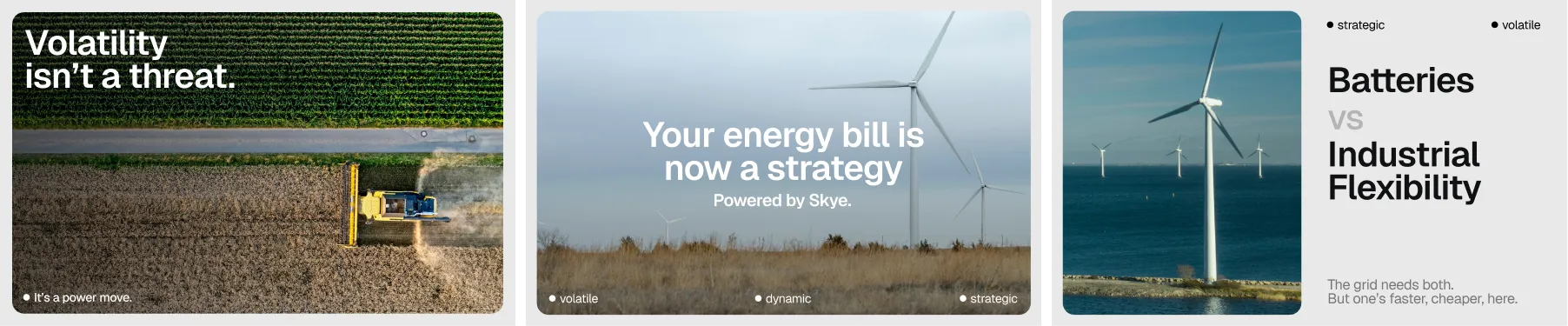
Skye had a real problem of communicating clearly. Multiple use cases, different market mechanisms, and a layer of optimisation that the customer is, by design, not meant to operate manually. For decision makers in heavy industry, that depth quickly turned into friction, and on top of the explanation problem, Skye did not yet have a steady content presence to build understanding over time. Existing materials were dense, technical, and built for an expert reader, while the people who actually approve a deployment, energy leads, CFOs, and operations directors, read with different priorities and different levels of patience. Skye needed two things at once: content that translates the product clearly, and a steady editorial output that puts that content in front of the right audiences month after month.
Content Strategy
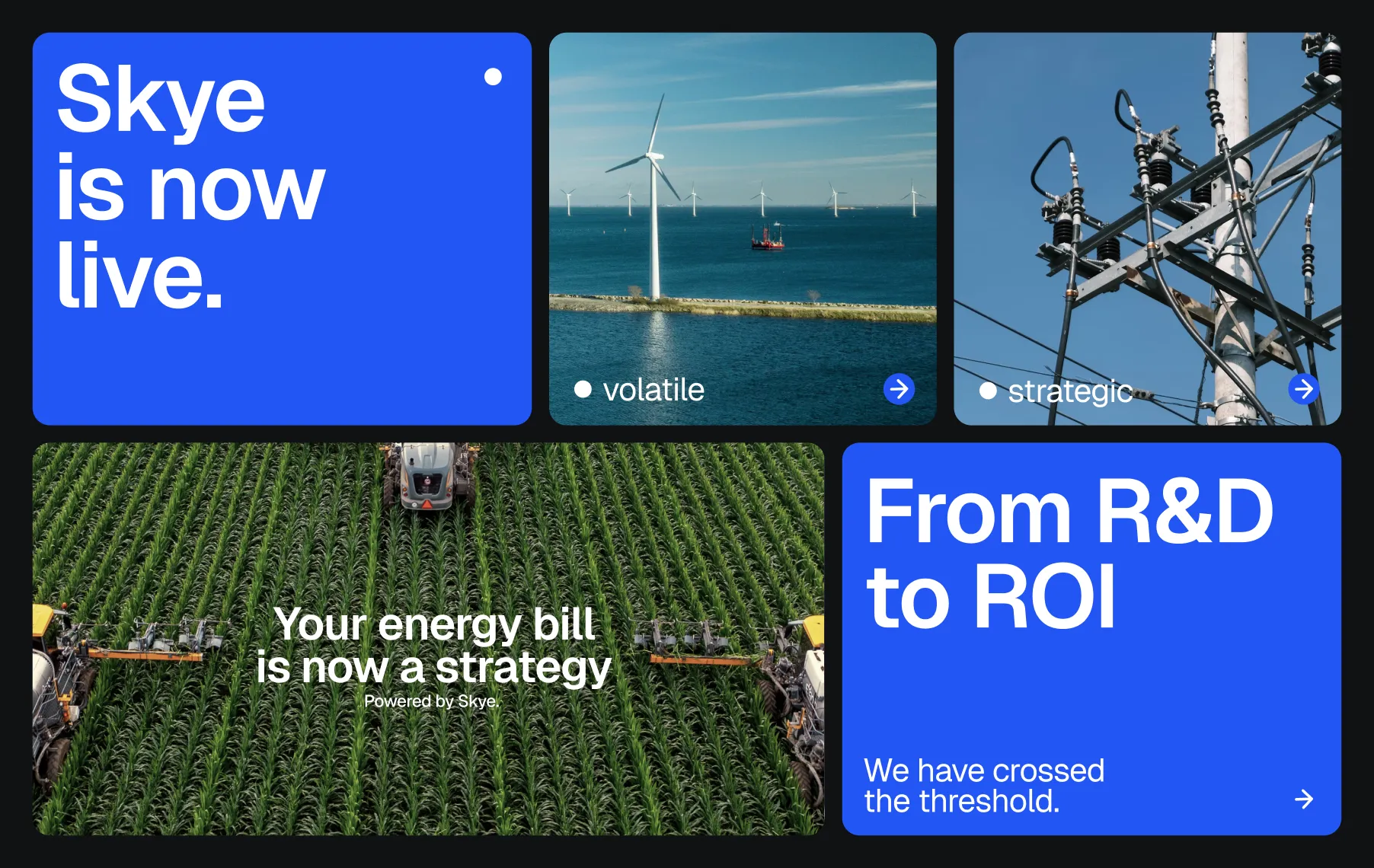
The strategy was built around a single move: opening the black box of the product. Rather than describing Skye through features or framing it as another piece of energy software, we positioned the content around showing the work, the assets, the markets, the decisions, and the outcomes, laid out in a way that makes the autopilot visible without diluting its sophistication.
From this we mapped a small number of recurring story types (customer scenarios, market mechanisms, technical explainers, point-of-view pieces, founder voice) and assigned each to the surfaces where it belonged: LinkedIn for ongoing presence, longform and whitepapers for depth, case studies for proof, sales collateral for the buying conversation.
Open the black box
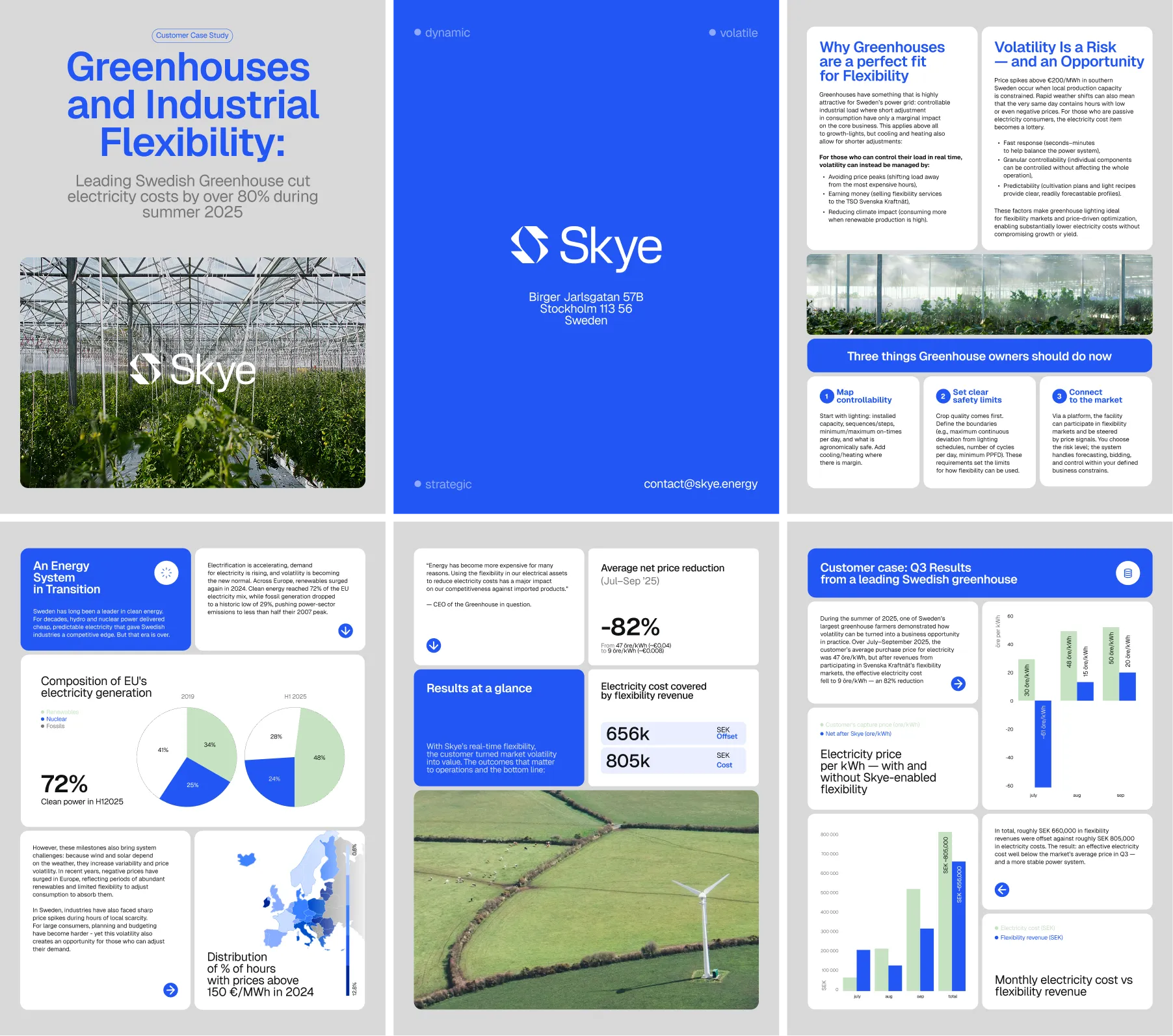
The idea behind the system is that Skye's product is, in a real sense, working underneath the customer's operations, and that the job of the content is to surface that work at the right altitude for each reader.
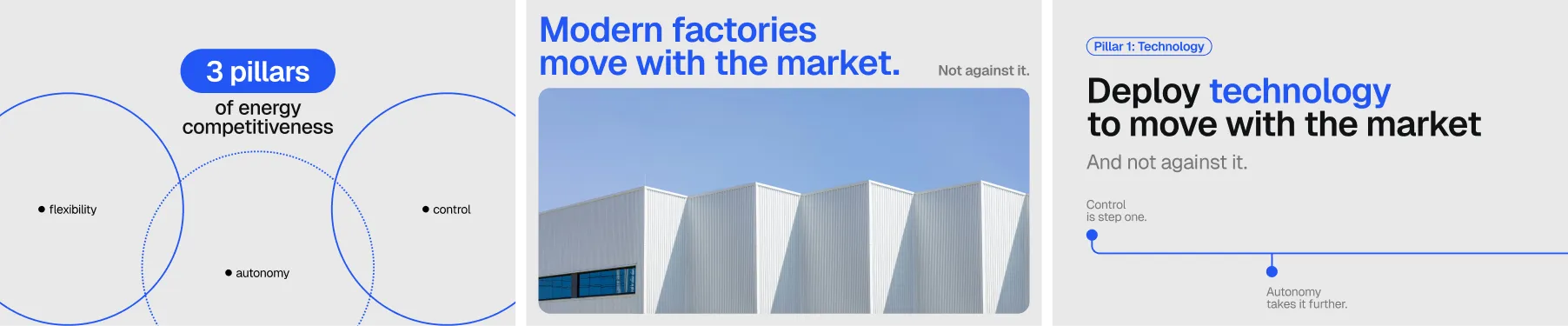
Every piece, whether a 200-word LinkedIn post or a 20-page whitepaper, is a small act of translation between what the software is doing and what the business is gaining. Three principles kept the work aligned across formats and across months: concrete, not conceptual (every story starts from real assets and real numbers); before and after (every case shows the change Skye makes visible); multi-layer legibility (an energy expert, a CFO, and an operations lead can each pull what they need from the same artefact at different reading depths).
Monthly Content
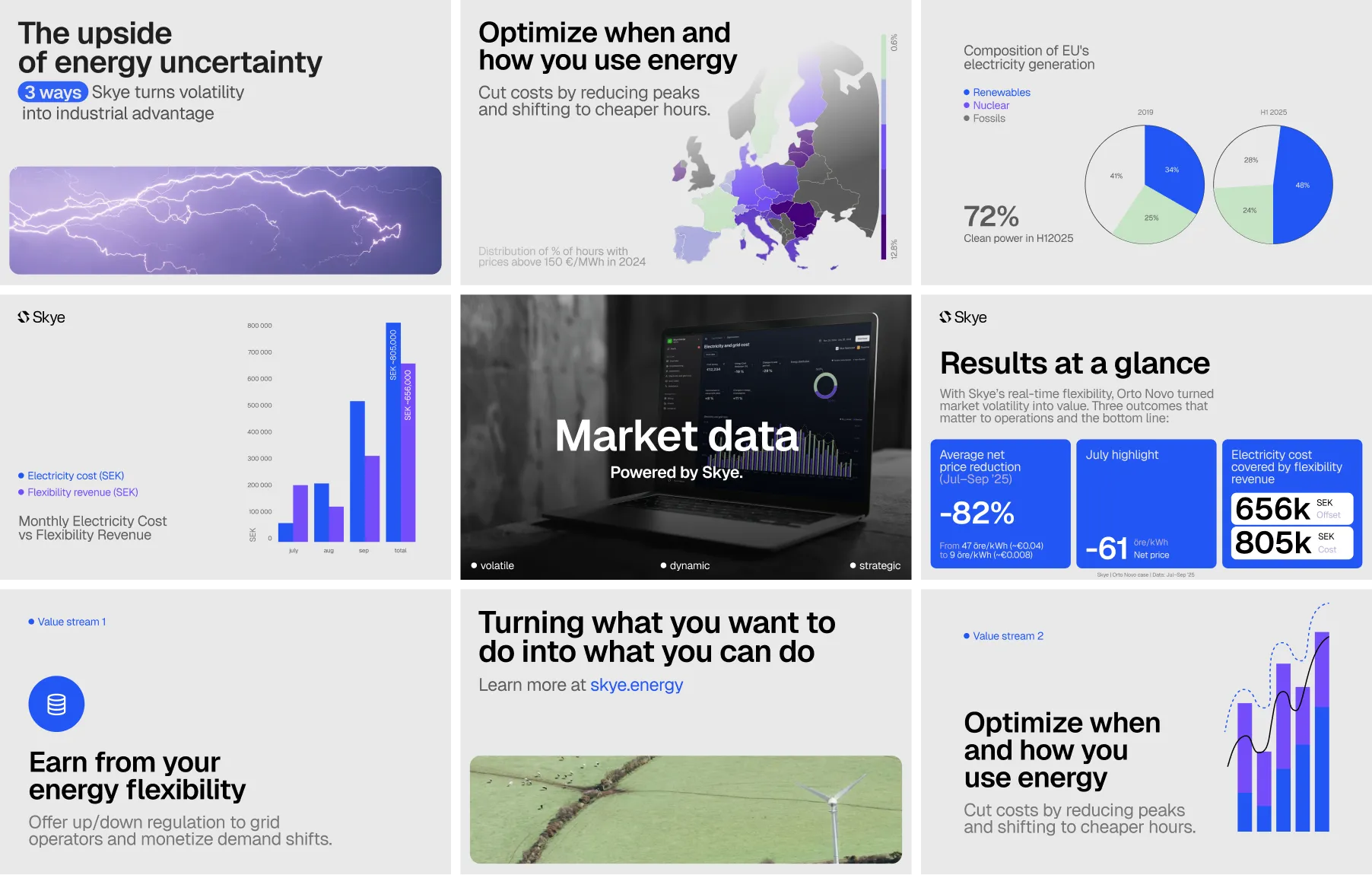
The core of the engagement was a steady monthly stream of brand content, planned, written, and produced end-to-end. LinkedIn posts ran on both the company page and the personal accounts of Skye's founders and team, building a layered presence where the company voice, the founder voice, and the technical voice all reinforced one another. Longform articles and whitepapers carried the heavier ideas, the market context, the technical depth, the points of view that sales decks cannot fit. Case studies arrived on a regular cadence rather than as one-off pieces, each built around a real customer scenario with a clear before/after spine: what the situation looked like, how Skye integrated with existing assets, and what changed in energy spend, market revenue, and grid impact. Sales collateral was produced on request to support live conversations, drawing on the same material so that what the buyer read on LinkedIn, what they downloaded as a whitepaper, and what their account team handed over in a meeting all spoke the same language.
Results
The clearest signal Skye reported back was the simplest one: their customers were starting to understand, faster, what Skye actually does. The friction at the front of the buying conversation began to ease. Calls opened from a different starting point, materials were doing more of the explanatory work before a meeting rather than during it, and the team could spend more of their time on the substance of a deployment instead of on the basics of the pitch. The content was no longer a side activity around the product; it had become an asset that worked alongside it, opening the black box one piece at a time.
Company
Skye
Industry
Energy Tech
AI
Solutions
Communication Strategy
Content
Building the content engine for an energy autopilot.
Skye is an energy autopilot for industry, software that lets factories intelligently participate in electricity markets using the assets they already have. The product sits at the intersection of industrial operations, electricity markets, and advanced optimisation, and most of the real intelligence happens in the background. We worked with Skye as their full content partner: developing the strategy, running the editorial calendar, and producing every piece of brand content in their monthly stream, from LinkedIn posts and longform articles to case studies, whitepapers, and sales collateral.
The Challenge
Skye had a real problem of communicating clearly. Multiple use cases, different market mechanisms, and a layer of optimisation that the customer is, by design, not meant to operate manually. For decision makers in heavy industry, that depth quickly turned into friction, and on top of the explanation problem, Skye did not yet have a steady content presence to build understanding over time. Existing materials were dense, technical, and built for an expert reader, while the people who actually approve a deployment, energy leads, CFOs, and operations directors, read with different priorities and different levels of patience. Skye needed two things at once: content that translates the product clearly, and a steady editorial output that puts that content in front of the right audiences month after month.
Content Strategy
The strategy was built around a single move: opening the black box of the product. Rather than describing Skye through features or framing it as another piece of energy software, we positioned the content around showing the work, the assets, the markets, the decisions, and the outcomes, laid out in a way that makes the autopilot visible without diluting its sophistication.
From this we mapped a small number of recurring story types (customer scenarios, market mechanisms, technical explainers, point-of-view pieces, founder voice) and assigned each to the surfaces where it belonged: LinkedIn for ongoing presence, longform and whitepapers for depth, case studies for proof, sales collateral for the buying conversation.
Open the black box
The idea behind the system is that Skye's product is, in a real sense, working underneath the customer's operations, and that the job of the content is to surface that work at the right altitude for each reader.
Every piece, whether a 200-word LinkedIn post or a 20-page whitepaper, is a small act of translation between what the software is doing and what the business is gaining. Three principles kept the work aligned across formats and across months: concrete, not conceptual (every story starts from real assets and real numbers); before and after (every case shows the change Skye makes visible); multi-layer legibility (an energy expert, a CFO, and an operations lead can each pull what they need from the same artefact at different reading depths).
Monthly Content
The core of the engagement was a steady monthly stream of brand content, planned, written, and produced end-to-end. LinkedIn posts ran on both the company page and the personal accounts of Skye's founders and team, building a layered presence where the company voice, the founder voice, and the technical voice all reinforced one another. Longform articles and whitepapers carried the heavier ideas, the market context, the technical depth, the points of view that sales decks cannot fit. Case studies arrived on a regular cadence rather than as one-off pieces, each built around a real customer scenario with a clear before/after spine: what the situation looked like, how Skye integrated with existing assets, and what changed in energy spend, market revenue, and grid impact. Sales collateral was produced on request to support live conversations, drawing on the same material so that what the buyer read on LinkedIn, what they downloaded as a whitepaper, and what their account team handed over in a meeting all spoke the same language.
Results
The clearest signal Skye reported back was the simplest one: their customers were starting to understand, faster, what Skye actually does. The friction at the front of the buying conversation began to ease. Calls opened from a different starting point, materials were doing more of the explanatory work before a meeting rather than during it, and the team could spend more of their time on the substance of a deployment instead of on the basics of the pitch. The content was no longer a side activity around the product; it had become an asset that worked alongside it, opening the black box one piece at a time.
Company
Skye
Industry
Energy Tech
AI
Solutions
Communication Strategy
Content
Building the content engine for an energy autopilot.
Skye is an energy autopilot for industry, software that lets factories intelligently participate in electricity markets using the assets they already have. The product sits at the intersection of industrial operations, electricity markets, and advanced optimisation, and most of the real intelligence happens in the background. We worked with Skye as their full content partner: developing the strategy, running the editorial calendar, and producing every piece of brand content in their monthly stream, from LinkedIn posts and longform articles to case studies, whitepapers, and sales collateral.
The Challenge
Skye had a real problem of communicating clearly. Multiple use cases, different market mechanisms, and a layer of optimisation that the customer is, by design, not meant to operate manually. For decision makers in heavy industry, that depth quickly turned into friction, and on top of the explanation problem, Skye did not yet have a steady content presence to build understanding over time. Existing materials were dense, technical, and built for an expert reader, while the people who actually approve a deployment, energy leads, CFOs, and operations directors, read with different priorities and different levels of patience. Skye needed two things at once: content that translates the product clearly, and a steady editorial output that puts that content in front of the right audiences month after month.
Content Strategy
The strategy was built around a single move: opening the black box of the product. Rather than describing Skye through features or framing it as another piece of energy software, we positioned the content around showing the work, the assets, the markets, the decisions, and the outcomes, laid out in a way that makes the autopilot visible without diluting its sophistication.
From this we mapped a small number of recurring story types (customer scenarios, market mechanisms, technical explainers, point-of-view pieces, founder voice) and assigned each to the surfaces where it belonged: LinkedIn for ongoing presence, longform and whitepapers for depth, case studies for proof, sales collateral for the buying conversation.
Open the black box
The idea behind the system is that Skye's product is, in a real sense, working underneath the customer's operations, and that the job of the content is to surface that work at the right altitude for each reader.
Every piece, whether a 200-word LinkedIn post or a 20-page whitepaper, is a small act of translation between what the software is doing and what the business is gaining. Three principles kept the work aligned across formats and across months: concrete, not conceptual (every story starts from real assets and real numbers); before and after (every case shows the change Skye makes visible); multi-layer legibility (an energy expert, a CFO, and an operations lead can each pull what they need from the same artefact at different reading depths).
Monthly Content
The core of the engagement was a steady monthly stream of brand content, planned, written, and produced end-to-end. LinkedIn posts ran on both the company page and the personal accounts of Skye's founders and team, building a layered presence where the company voice, the founder voice, and the technical voice all reinforced one another. Longform articles and whitepapers carried the heavier ideas, the market context, the technical depth, the points of view that sales decks cannot fit. Case studies arrived on a regular cadence rather than as one-off pieces, each built around a real customer scenario with a clear before/after spine: what the situation looked like, how Skye integrated with existing assets, and what changed in energy spend, market revenue, and grid impact. Sales collateral was produced on request to support live conversations, drawing on the same material so that what the buyer read on LinkedIn, what they downloaded as a whitepaper, and what their account team handed over in a meeting all spoke the same language.
Results
The clearest signal Skye reported back was the simplest one: their customers were starting to understand, faster, what Skye actually does. The friction at the front of the buying conversation began to ease. Calls opened from a different starting point, materials were doing more of the explanatory work before a meeting rather than during it, and the team could spend more of their time on the substance of a deployment instead of on the basics of the pitch. The content was no longer a side activity around the product; it had become an asset that worked alongside it, opening the black box one piece at a time.