Why SaaS Companies Outgrow Their Brand Strategy Faster Than They Think
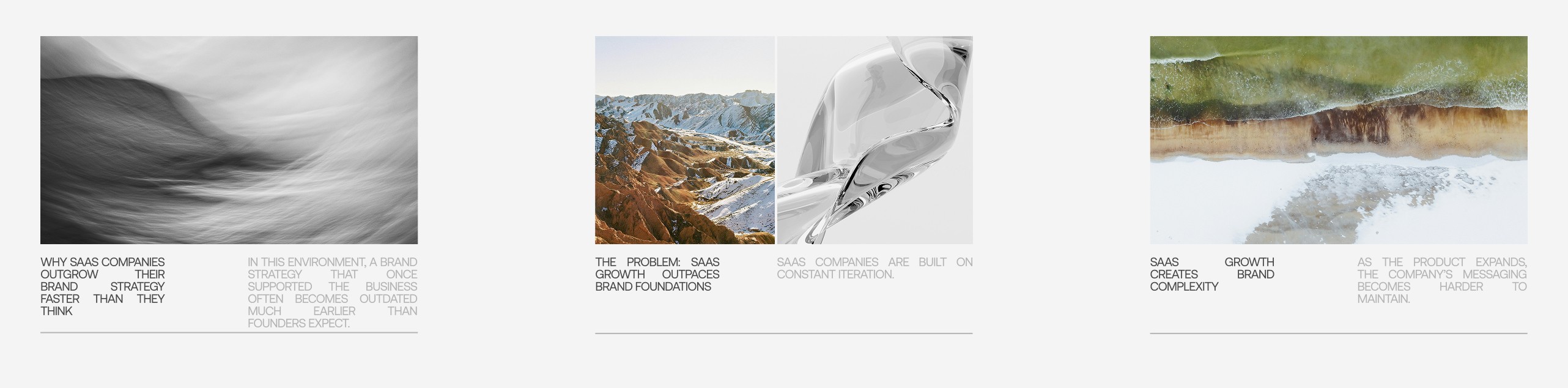
SaaS companies move quickly. Product teams ship new features every week, sales teams expand into new markets and marketing teams push continuous campaigns to meet ambitious revenue growth targets. In this environment, a brand strategy that once supported the business often becomes outdated much earlier than founders expect. As the business model evolves, the value proposition shifts and the customer journey becomes more complex, many SaaS companies discover that their existing brand strategy can no longer support their marketing efforts, their go to market strategy or their positioning in a crowded market.
A strong saas brand is not simply a visual identity or a collection of assets. It is a flexible system that aligns marketing teams, sales teams and product teams around how the company defines its unique value and communicates it to potential customers, existing customers and enterprise customers. When this system does not evolve, companies struggle with customer acquisition, content marketing, social media marketing, lead generation and customer retention. They invest more in paid ads, build larger marketing plans and create more content, yet see little improvement in awareness, engagement or revenue growth.
This article explains why SaaS companies outgrow their brand strategy so quickly, how to recognize the early symptoms and what is required to rebuild a brand architecture that supports scalable SaaS marketing strategy and long term business growth.
The Problem: SaaS Growth Outpaces Brand Foundations
SaaS companies are built on constant iteration. New features, pricing models, integrations and product expansions happen far faster than in traditional marketing environments. But while the saas product evolves at high speed, the brand strategy often remains unchanged. This creates a gap between how the company sees itself internally and how the market understands it externally.
SaaS growth creates brand complexity
As the product expands, the company’s messaging becomes harder to maintain. What once was a simple value proposition must now reflect multiple use cases, different target customers and a wider range of problems. Without updating the brand foundations, messaging becomes fragmented and inconsistent across marketing channels, from google ads and email marketing to content marketing strategy and social media posts.
Scaling accelerates customer acquisition needs
SaaS businesses rely heavily on acquiring new customers through organic traffic, search engines, paid advertising and referral marketing. When the brand strategy is outdated, CAC increases. Customers need more touchpoints to understand the saas solution, which slows down sales cycles and reduces conversion rates.
Internal alignment breaks as teams grow
Marketing teams, sales teams and customer success teams often use different descriptions of the same product. Without a shared framework, product updates outpace brand coherence. The brand no longer reflects the company’s competitive advantage or the real value its saas strategies provide.
Signs Your SaaS Brand Strategy Is Outdated
Founders often notice symptoms long before they identify the root cause.
1. Messaging fragmentation
Different landing pages, campaigns, nurture emails and customer success materials describe the saas product differently. This reduces brand visibility and confuses prospective customers.
2. Inconsistent value proposition
If the value proposition shifts depending on the marketing channel or the audience segment, it is a sign that the brand strategy is no longer aligned with business goals.
3. Declining performance in content marketing
SaaS content marketing depends on clarity. When the brand strategy is outdated, even strong content marketing efforts fail to reach ideal customers or reflect real customer pain points.
4. Increased customer acquisition cost
As positioning becomes unclear, the company needs more paid ads and higher marketing budget to reach the same volume of paying customers or new customers.
5. Brand perception drifts
Customer feedback becomes inconsistent, customer testimonials feel generic and brand associations no longer match the company’s true value.
When Scaling Demand Breaks Static Positioning
Static brand positioning cannot support a dynamic saas business. As demand grows, the company needs to speak to broader segments, from SMB buyers to enterprise customers, each with different expectations and purchasing decisions.
The original brand narrative becomes too narrow
Early positioning typically focuses on a single pain point or feature. As the business model expands, this narrow message limits growth. The brand must reflect the breadth of solutions rather than a single problem.
Multi product portfolios create confusion
Many saas businesses add new features or modules that do not fit neatly into the original brand strategy. Customers cannot understand how new offerings relate to the core saas product, which decreases relevance and slows down adoption.
Scaling reveals new competitors
As companies target a wider market, they encounter different competitors with stronger brand strategies. Without refining brand positioning, it is difficult to maintain competitive advantage in the saas industry.
Demand generation depends on clarity
The saas marketing funnel functions best when positioning is clear. When the brand architecture is outdated, marketing campaigns cannot scale effectively across channels such as social media marketing, SEO strategy or account based marketing.
Why SaaS Marketing Strategy Needs System Level Narrative Coherence
SaaS marketing is not a collection of isolated tactics. It is a system that depends on narrative coherence. When the story behind the saas product is unclear, marketing tactics compete with each other instead of reinforcing one another.
Narrative coherence strengthens marketing campaigns
With a clear brand strategy, each marketing tactic supports the same message. Whether the company invests in google ads, paid ads, saas content marketing or SEO strategy, the message remains consistent and aligned with the target market.
It reduces cognitive load for customers
Busy buyers do not have time to decode complex positioning. Narrative coherence helps customers understand the unique value of the saas solution quickly, which shortens sales cycles and improves customer experience across the customer journey.
It reduces reliance on marketing budget
When messaging is confusing, companies compensate by spending more on media. When narrative coherence is strong, organic traffic and content performance improve, reducing cost per lead and improving conversion rates.
It improves alignment between sales and marketing
A coherent narrative ensures sales teams and marketing teams share the same buyer personas and messaging, which improves lead quality and revenue growth.
How SaaS Business Strategy Impacts Brand Strategy Evolution
A saas brand must evolve alongside its business strategy. When the business changes, the brand must change as well.
Changes in business model require repositioning
SaaS companies frequently adjust pricing models, expand internationally or shift ICPs. These changes reshape the company’s brand and influence how the company communicates value to potential customers.
Product expansion requires updated architecture
As companies introduce new modules or expand the platform, they need a brand architecture that makes relationships between offerings clear.
New markets require new messaging
Expanding into enterprise customers or new industries requires updated brand narratives. The original brand strategy often cannot support this level of complexity.
Customer success becomes part of the narrative
Modern B2B SaaS companies rely on strong customer success programs. Customer success influences brand perception, brand awareness and brand loyalty, which means the brand strategy must incorporate this part of the business.
Why Rebranding or Refreshing Is Essential for SaaS
Rebrands and brand refreshes are not cosmetic changes. In SaaS, they are a necessary part of business evolution.

Rebrands help realign value proposition and market reality
As saas companies grow, the value they deliver becomes more complex. A refresh helps realign messaging, visual identity and value propositions with actual customer needs.
It helps clarify competitive advantage
In a crowded market where many saas companies compete for visibility, a rebrand helps clarify what makes the company unique.
Rebranding supports customer retention
When messaging is clearer and user expectations better managed, customer retention improves. Clear communication reduces frustration and increases brand loyalty among existing customers.
Rebrand timing is critical
The best time for a rebrand is before growth plateaus, not after. Companies that wait too long risk losing relevance.
Rebuilding Brand Architecture Before Growth Plateaus
When saas companies update their brand architecture early, they prevent stagnation and unlock new growth.
Brand architecture connects the entire marketing plan
A clear architecture improves every part of the marketing plan, from email marketing to lead generation and referral marketing.
It makes acquisition and retention measurable
With a structured system, teams can measure how brand visibility, market relevance or customer satisfaction impact growth.
It clarifies the role of each product
A strong architecture explains how features and modules support the platform, which improves adoption.
It prepares the company for enterprise scale
SaaS companies entering enterprise markets need strong brand systems to compete with established players.
Brand Strategy Examples
HubSpot, Evolving the Brand as the Product Ecosystem Expands
HubSpot shows how saas companies can successfully refresh brand strategy as the business model evolves. By aligning narrative, visual identity and product naming around a broader CRM platform, HubSpot created clarity for both potential customers and existing customers. This updated architecture strengthened performance across marketing channels, improved customer experience and expanded the company’s competitive advantage in the saas industry.
Atlassian, Maintaining Narrative Coherence Across Rapid Expansion
Atlassian demonstrates how consistent brand strategy supports long term business growth. By organizing products under a clear and accessible architecture, the company helped target customers understand how each product fits into the overall platform. This structure improved brand visibility, increased customer retention and allowed the company to scale without losing coherence.
FAQ
Why do SaaS companies outgrow their brand strategy so quickly
Because SaaS businesses evolve faster than their original positioning, forcing companies to update value propositions, messaging and product narratives to reflect market needs.
What triggers a SaaS brand refresh
Common triggers include new markets, new features, changing ICPs, increased competition and declining performance across marketing channels.
How can SaaS companies maintain narrative coherence across rapid iteration
By using clear brand architecture that aligns messaging, product structure and marketing tactics across teams.
What role does brand architecture play in SaaS scaling
It provides structure for positioning, clarifies product relationships, improves customer experience and strengthens the effectiveness of the saas marketing strategy.

Masha is the founder of Bolder, a branding and communications agency for tech startups in AI, robotics, biotech, deep tech, and energy. She’s built three companies and leads a team of talented strategists and designers, helping technical founders turn hard to explain work into brands sharp enough to match the tech behind them.